

Introduction: What is Inducement in Forex?
Inducement in forex is when the market moves in one direction on purpose — just to trick traders into entering a trade — and then reverses sharply the other way.
Think of it like a bait trap. The market “shows” you something that looks real. You jump in. Then it goes the opposite way.
Why must traders understand it?
If you don’t know about inducement, you will keep losing trades and never know why. Most retail traders fall into these traps every single day.
Quick example:
Imagine price is moving up and breaks a recent high. You think, “Great! This is a breakout!” You buy. Then suddenly, price drops hard and hits your stop loss. That was inducement.

Why Inducement Happens in the Forex Market
Big players — like banks and institutions — need a lot of buy or sell orders to move their huge positions. They can’t just click a button and enter like you do.
They need liquidity. And who provides that? Retail traders like us.
Simple story — “Trap and Move”:
Imagine a big fish in a pond. It moves the water to push small fish into one corner. Then it eats them all at once. That’s exactly what happens in forex. Big money pushes price into an area where retail orders are sitting — then collects them all and moves the real direction.
This is the heart of the forex inducement strategy.

Who Creates Inducement? (Smart Money Explained)
Banks and institutions move billions of dollars every day in the forex market. They plan their entries carefully. They know where retail traders place their stops and entries.
Market makers are companies or banks that provide prices to the market. They often know where most orders are sitting. So they can move price toward those areas first before reversing.
Retail vs Smart Money:
| Retail Traders | Smart Money |
|---|---|
| React to price | Plan price movement |
| Chase breakouts | Set the traps |
| Follow indicators | Follow liquidity |
| Enter early | Enter after liquidity is collected |
Smart money concepts forex traders use always focus on where liquidity is hiding — not just where price is going right now.
How Inducement Works (Step-by-Step)
Here’s exactly how inducement in forex plays out:
- Price moves in one direction — looks like a strong trend or breakout
- Retail traders enter — thinking it’s a real move
- Liquidity builds up — stop losses and pending orders pile up
- Price reverses sharply — smart money collected what it needed
This is how inducement forex explained works in real life. The move that looks like a breakout is actually a collection of retail orders. Once collected, price moves the real direction.
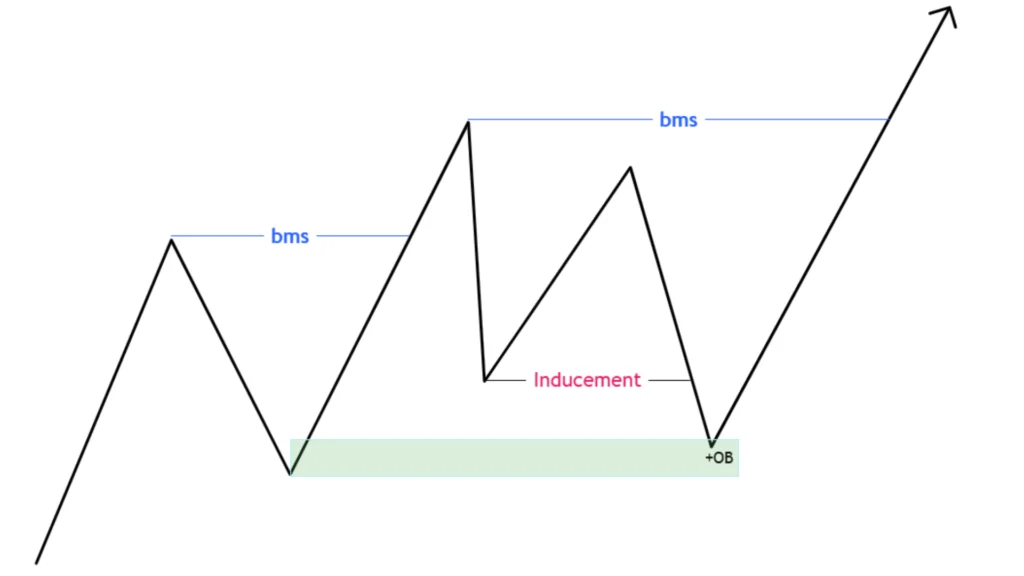
Key Concepts You Must Understand First
Market Structure (BOS & CHOCH)
Market structure means the way price moves — higher highs and higher lows in an uptrend, lower highs and lower lows in a downtrend. A Break of Structure (BOS) means price broke a recent swing high or low. A Change of Character (CHOCH) means the trend is shifting. Inducement in market structure often happens right before a BOS or CHOCH.
Liquidity (Buy-side & Sell-side)
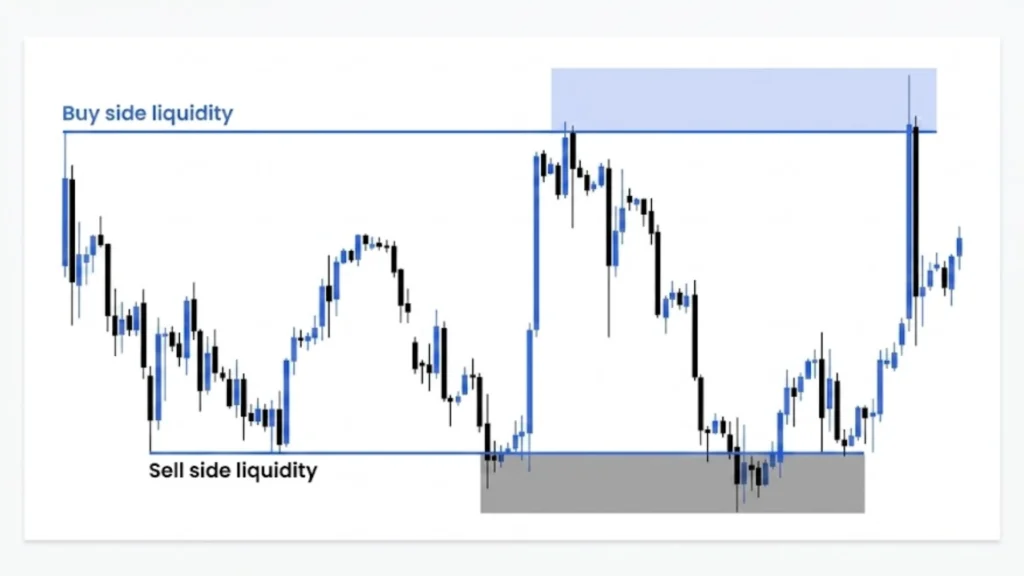
Buy-side liquidity sits above recent highs — that’s where traders have placed their stop losses from short trades and pending buy orders. Sell-side liquidity sits below recent lows. Smart money targets these areas. Liquidity inducement trading is all about finding these pools.
Order Blocks (Basic Idea)
An order block is the last candle before a big move. Banks often leave their orders there. When price comes back to that area, it often reacts strongly. Inducement and order blocks work together — inducement often leads price back to an order block.
Supply and Demand Zones
Supply zones are areas where price dropped sharply from. Demand zones are areas where price rose sharply from. Inducement at support and resistance levels often happens near these zones to grab liquidity before the real move.
Types of Inducement in Forex
Support & Resistance Inducement (False Breakouts)
Price breaks above a well-known resistance level. Traders buy. Then price quickly falls back below and drops hard. This is a classic false breakout forex strategy trap. The break was only to collect buy orders above resistance.
Trendline Inducement
Price breaks below a trendline. Traders sell. Then price shoots up and never looks back. Trendline inducement forex happens when everyone is watching the same line — making it a perfect liquidity target.
Range / Consolidation Inducement
In a sideways market, price breaks one side of the range — grabs stops — then breaks the other side. Range inducement trading is very common in quiet market hours.
Premature Reversal Inducement
Price looks like it’s reversing. Traders enter the reversal early. Then price continues in the original direction first — hits their stops — and then actually reverses. Patience is the key here.
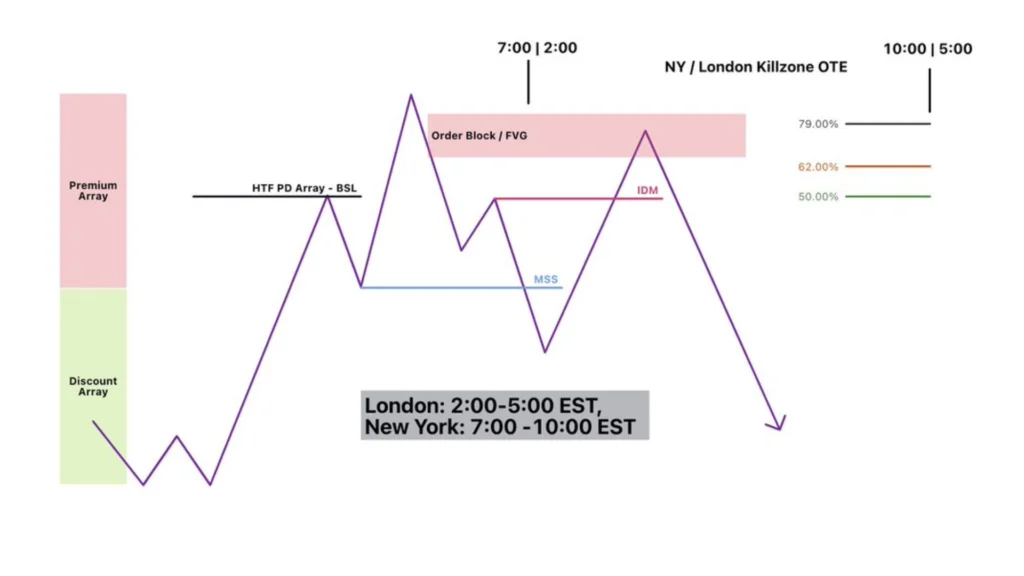
Session-Based Inducement (London/New York)
This happens at the start of major sessions. Session-based inducement traps early traders who jump in at the open before the real move is set.
Inducement vs Similar Concepts (Avoid Confusion)
Inducement vs Liquidity Grab
A liquidity grab is a quick spike to collect orders. Inducement is a more planned move that creates a “believable” setup to trap traders. Inducement vs liquidity grab — both are traps, but inducement is more deceptive and slower.
Inducement vs Pullback
A pullback is a normal, healthy retracement in a trend. Inducement vs pullback — a pullback moves with structure; inducement breaks structure briefly to trap traders before reversing.
Inducement vs Fake Breakout
These are very similar. The difference: inducement vs fake breakout — a fake breakout is the event, inducement is the reason behind it. Inducement is the strategy; the fake breakout is the tool.
How to Identify Inducement on Charts (Step-by-Step)
Here’s how to identify inducement in forex step by step:
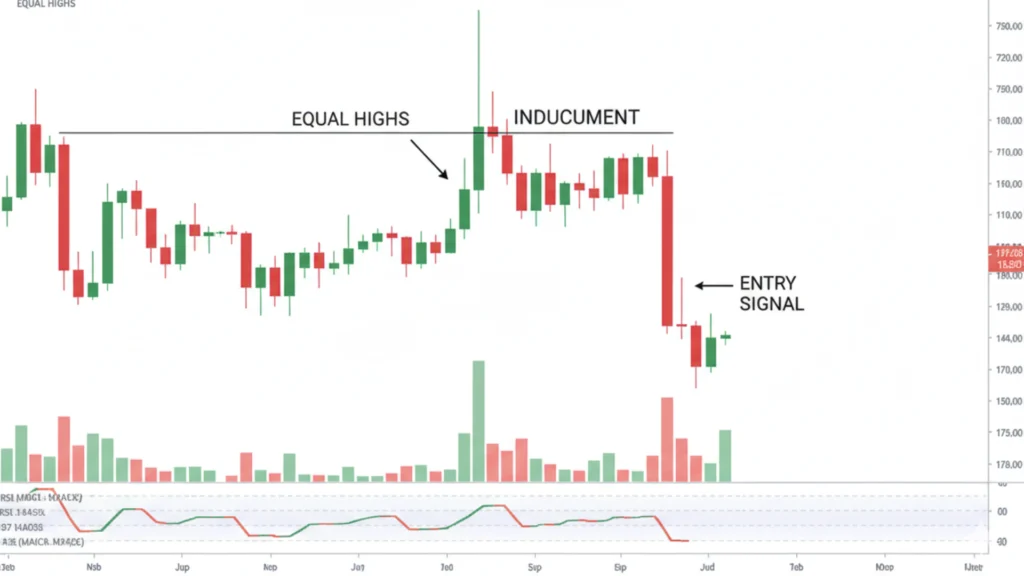
- Look for equal highs or equal lows — these are liquidity magnets
- Watch for a fake breakout above those levels
- Identify the liquidity zone that was just swept
- Wait for a structure shift — a candle closing back inside the range
- Look for confirmation like a strong rejection candle or order block reaction
How to trade inducement forex always starts with patience. Don’t enter during the trap move. Wait for the reversal confirmation.
What Retail Traders Think vs What Smart Money Does
Retail traders think: “Price is breaking a level — this is a signal! I need to enter now!”
Smart money does: “Perfect. Retail traders are buying. Now we have the liquidity we need to sell our huge position.”
This simple mindset shift is everything. Stop loss hunting forex is not random — it’s planned. When you understand this, you stop being the prey and start trading with the big players.
Inducement Trading Strategy (Complete Setup)
Here’s a complete inducement trading setup:
- Step 1: Identify the trend on a higher timeframe
- Step 2: Mark buy-side and sell-side liquidity zones
- Step 3: Wait for an inducement move into that liquidity
- Step 4: Confirm with a break of structure in the opposite direction
- Step 5: Enter after confirmation candle closes
This is the core of the advanced inducement trading strategy. Simple but powerful when done with discipline.
Entry, Stop Loss, and Take Profit Rules
- Entry: After the confirmation candle closes — never before
- Stop loss: Place it above or below the liquidity zone that was swept (inducement risk management forex)
- Take profit: Target the next liquidity zone or swing high/low
- Risk-to-reward: Aim for minimum 1:2 — meaning risk $1 to make $2
Inducement entry and exit strategy is clean when you follow these rules strictly.
Best Timeframes for Inducement Trading
- Higher timeframe (H4 or Daily): Find the trend and liquidity zones
- Lower timeframe (H1 or M15): Look for the inducement and entry confirmation
Best timeframe for inducement trading example: Use H4 for direction, M15 for your entry. Multi timeframe inducement analysis gives you a clearer picture.
Best Forex Pairs for Inducement
Major pairs like EUR/USD and GBP/USD are the best for inducement trading because they have the highest liquidity. More liquidity means cleaner traps and faster reversals. Exotic pairs have irregular moves and are harder to read.
Best Trading Sessions for Inducement
- London Session: High volatility, lots of inducement setups at session open
- New York Session: Another wave of volatility, especially during the overlap with London
Low-volatility sessions like the Asian session often just build liquidity for the London and NY sessions to sweep. Volatility is what makes inducement work.
Real Example of Inducement (Story Format)
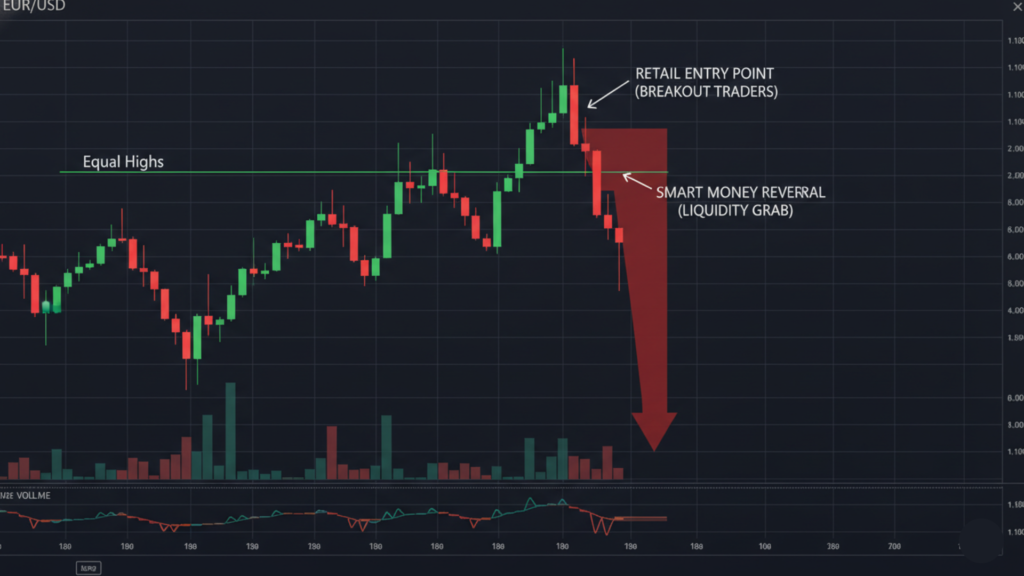
Here’s a real inducement trading example told as a story:
Price on EUR/USD created equal highs at 1.0900 over two days. Retail traders noticed and placed buy orders just above that level. On Tuesday morning, price pushed above 1.0900. Traders entered — excited about the breakout. Then suddenly, in just 30 minutes, price crashed back down and kept falling for 200 pips. Every single buy stop was hit. Smart money had collected all those buy orders and used them to sell their massive positions. Classic inducement in price action.
Failed Inducement (When It Doesn’t Work)
Sometimes what looks like inducement doesn’t reverse. This is called failed inducement.
Signs of failure:
- Weak rejection — price barely comes back after the sweep
- Multiple attempts to break the level — shows real buying pressure
- Fast reversal back above the swept level
Opportunity insight: Failed inducement often means the real breakout is coming. If price sweeps a level and comes back twice without reversing strongly — the trend might actually be continuing. Adapt and don’t force the trade.
Common Mistakes Traders Make
- Entering too early — jumping in during the trap instead of waiting for confirmation
- Ignoring confirmation — no structure break = no trade
- Overtrading — not every move is inducement
- Misunderstanding structure — confusing a real break of structure with an inducement move
How to Avoid Inducement Traps
- Wait for confirmation before entering any trade
- Don’t chase breakouts — if you missed it, let it go
- Focus on liquidity zones — know where stops are sitting
- Be patient — how to avoid inducement traps is mostly about doing nothing until the right moment
Forex liquidity traps are everywhere. Your job is to spot them — not fall into them.
Risk Management for Inducement Trading
- Risk only 1–2% per trade — protect your account
- Use proper lot size based on your stop loss distance
- Avoid revenge trading — if you got trapped, don’t immediately re-enter out of anger
Good risk management means you can survive many wrong trades and still grow your account over time.
Inducement Trading Checklist (Quick Guide)
Use this forex inducement checklist before every trade:
- ✅ Is there liquidity nearby? (equal highs/lows, stop clusters)
- ✅ Did price fake the breakout?
- ✅ Is the structure broken after the sweep?
- ✅ Do I have a confirmation candle or pattern?
- ✅ Is my risk-to-reward at least 1:2?
How to Practice Inducement (Beginner Guide)
Inducement forex for beginners starts with practice — not live trading.
- Use chart replay on TradingView to go back in time and practice
- Backtest past charts — mark every inducement you can find on historical data
- Mark setups daily — even when not trading, annotate your charts
The more you see it, the faster you’ll recognize it in real time.
When NOT to Trade Inducement
- During news events — price moves are unpredictable and driven by fundamentals
- In low volatility markets — no liquidity to grab means no clean inducement
- When structure is unclear — if you can’t read the chart clearly, don’t trade
Tips to Become Consistent in Inducement Trading
- Be patient — wait for the full setup, not just one piece of it
- Follow your rules strictly — emotion is your biggest enemy
- Focus on quality trades — 2 good trades a week beats 20 bad ones
Institutional trading strategies forex traders use are all about consistency and discipline over time.
Key Takeaways
- Inducement in forex is a planned trap to collect retail liquidity
- Smart money creates the trap; retail traders fall into it
- Always wait for structure confirmation before entering
- Use higher timeframes for direction and lower for entry
- Risk management is non-negotiable
- Practice on past charts before trading live
Frequently Asked Questoins And Answers
Question: What is inducement in forex?
Answer: Inducement in forex is when price moves in a false direction to trap traders, collect their stop losses, and then reverse the real way.
Question: How does inducement work?
Answer: Smart money pushes price into a liquidity zone, triggers retail stops, collects orders, and then moves price in the opposite direction.
Question: How to identify inducement?
Answer: Look for equal highs/lows, a false breakout above/below them, and then a sharp reversal with a break of structure.
Question: Inducement vs liquidity?
Answer: Liquidity is the pool of orders sitting in the market. Inducement is the act of moving price to collect that liquidity.
Question: Can beginners trade inducement?
Answer: Yes! Inducement forex for beginners is very learnable. Start with chart replay, keep it simple, and focus on one setup at a time.
Conclusion
Inducement in forex is one of the most powerful concepts in modern trading. Once you understand how smart money moves price to collect liquidity, you stop making the same mistakes over and over.
It takes time. It takes practice. But every chart you study and every setup you mark brings you closer to trading with confidence instead of confusion.
Be patient. Follow your checklist. Protect your capital. And remember — the goal isn’t to trade every move. It’s to trade the right ones.
