

Imagine you see the same chocolate bar costs $1 at Store A but $1.20 at Store B. If you buy from Store A and sell to Store B at the same time, you make 20 cents instantly. That’s arbitrage forex in its simplest form!
In currency markets, arbitrage forex means buying and selling the same currency pair when prices don’t match across different places. The price difference becomes your profit without waiting or guessing which way the market moves.
Unlike normal trading where you hope prices go up or down, arbitrage forex trading looks for existing gaps between prices right now. You’re not predicting the future—you’re catching mistakes in pricing that happen in real time.
This works because the forex market is massive and spreads across different countries and brokers. Sometimes prices take a few seconds to match everywhere, creating forex price discrepancies that quick traders can capture.
The goal is simple: buy low somewhere, sell high somewhere else, keep the difference. When done right, it feels almost magical because the profit appears without market risk.

Arbitrage Forex vs Normal Forex Trading
Regular forex trading is like guessing if it will rain tomorrow. You buy if you think prices go up. You sell if you think they’ll drop. You might be right or wrong.
Arbitrage forex works totally differently. You don’t guess at all. You simply find the same currency pair showing different prices in two places and trade both sides instantly.
Normal traders might hold positions for hours or even weeks. Those doing arbitrage forex trading usually close everything within seconds or minutes. Speed matters more than patience here.
Risk levels are completely different too. Traditional trading carries market risk—prices can move against you and cause losses. A currency arbitrage strategy aims to lock in profit immediately with matching trades.
Think of it this way: regular trading is sailing a boat where wind direction matters. Arbitrage forex is like standing on two boats moving apart and keeping the rope between them—you profit from the gap without caring about wind.
However, calling it risk-free forex arbitrage isn’t completely accurate in real life. Technology delays, broker rules, and fees can still create problems.

Why Price Differences Exist in Forex
You might ask: why aren’t prices exactly the same everywhere? Good question!
First, information moves fast but not instantly. Even tiny delays of milliseconds create opportunities for high-frequency arbitrage forex traders with super-fast computers.
Second, different brokers connect to different banks for prices. One broker gets quotes from Deutsche Bank while another uses Citibank. These sources might differ slightly.
Third, each broker adds their own spread to make money. These markups vary between companies, creating small forex market inefficiencies.
Fourth, trading volume affects pricing speed. When thousands of traders suddenly buy EUR/USD on one platform, that broker’s price might jump before others catch up.
Fifth, some brokers use market maker models where they set their own prices. Others use ECN models showing real interbank rates. This difference creates broker arbitrage opportunities.
Network speed also plays a role. A broker with servers in London might update EUR prices faster than one with servers in Asia during European trading hours.
These tiny gaps—often just a few pips—disappear within seconds as the market corrects itself. That’s why spotting and acting on forex price discrepancies requires lightning-fast execution.
Types of Arbitrage Forex (Easy Breakdown)
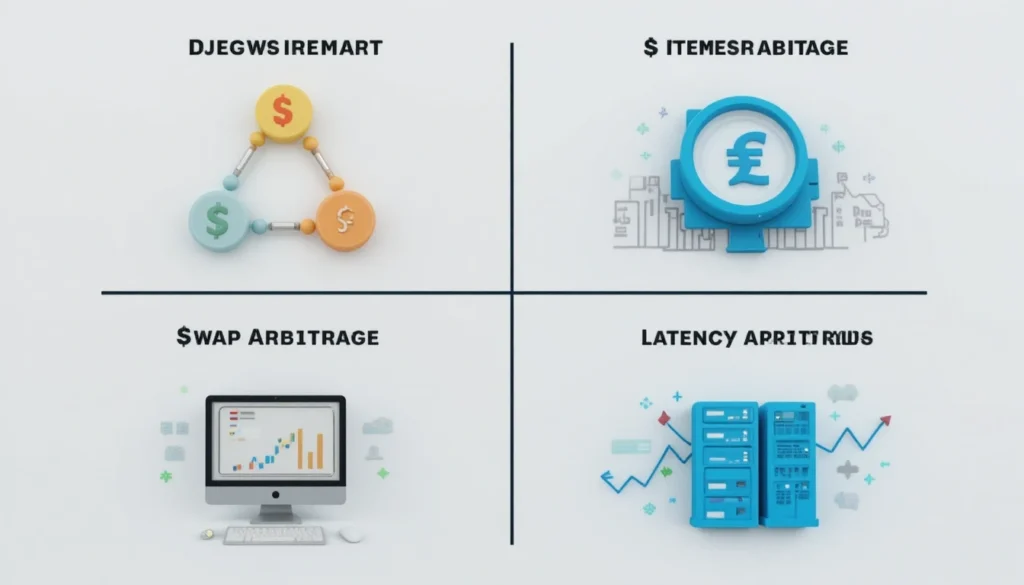
Let’s break down the main types you’ll encounter:
Triangular Arbitrage Forex
This method uses three different currency pairs to complete a circle. For example, you trade EUR/USD, then USD/JPY, then EUR/JPY back to where you started.
If the math between these three pairs doesn’t add up perfectly, there’s profit hiding in the middle. It’s like exchanging dollars for euros, euros for yen, then yen back to dollars and somehow ending with more dollars than you started.
This requires fast calculations and even faster execution. Most retail traders find triangular arbitrage forex too complex without special software.
Broker Price Arbitrage
This is the easiest type to understand. You open accounts with two different brokers and watch for moments when they show different prices for the same currency pair.
When Broker A shows EUR/USD at 1.0850 and Broker B shows 1.0855, you buy from A and sell to B simultaneously. The 5-pip difference is yours to keep.
This multi-broker arbitrage forex sounds simple but requires careful attention to spreads and fees, which we’ll cover later.
Swap Arbitrage
Some brokers pay you interest for holding certain positions overnight. Others charge you interest. If you find a pair where one broker pays more than another charges, you can profit from the interest difference.
This works on longer timeframes compared to other arbitrage methods. It’s less about speed and more about finding the right broker combinations.
Latency Arbitrage Forex
This controversial method uses technology speed advantages. Some traders place their servers right next to broker data centers to get price information microseconds faster than others.
They see price changes before slower traders and jump on opportunities. However, many brokers consider this unfair and will ban accounts using latency arbitrage forex tactics.
It requires expensive technology and often violates broker terms of service. Most beginners should avoid this path entirely.
Step-by-Step Forex Arbitrage Example (Beginner Friendly)
Let’s walk through a simple broker arbitrage example that shows how forex arbitrage works in real trading:
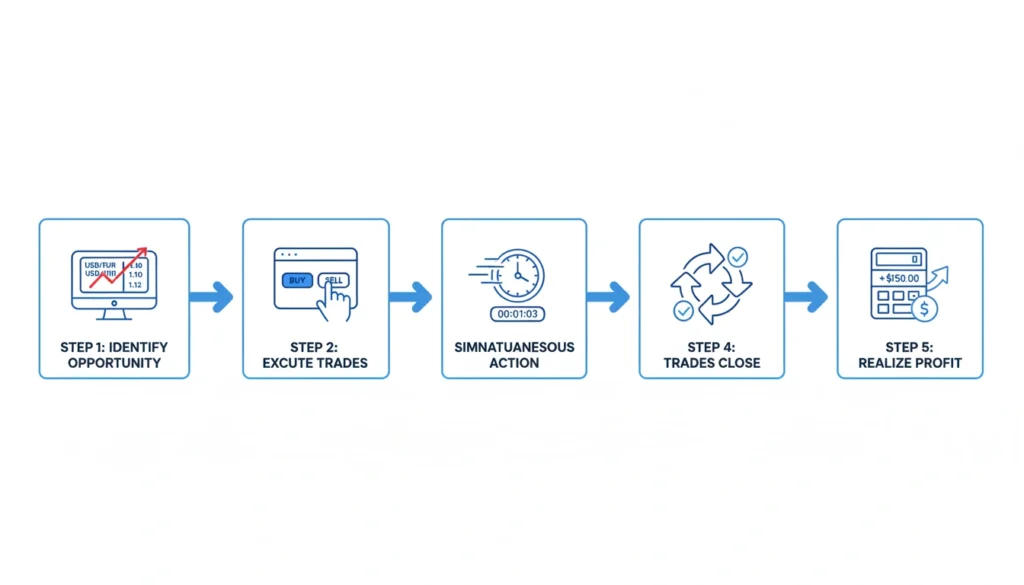
Step 1: Find the Price Difference
You’re watching EUR/USD on two broker platforms. Broker A shows 1.0850 and Broker B shows 1.0856. That’s a 6-pip gap—perfect for arbitrage.
Step 2: Open Both Trades Instantly
On Broker A, you buy 1 lot of EUR/USD at 1.0850. At the exact same moment, you sell 1 lot of EUR/USD on Broker B at 1.0856.
Step 3: Wait for Prices to Match
Within seconds, both brokers update and show 1.0853. The gap has closed—this is your exit moment.
Step 4: Close Both Positions
You close the buy trade on Broker A at 1.0853 (3 pips profit). You close the sell trade on Broker B at 1.0853 (3 pips profit).
Step 5: Count Your Profit
With standard lot sizing, each pip equals about $10. You made 3 pips on Broker A ($30) and 3 pips on Broker B ($30), totaling $60 before fees.
This example shows arbitrage forex explained in the simplest way possible. Real execution happens much faster and requires automated systems for best results.
Tools You Need for Forex Arbitrage
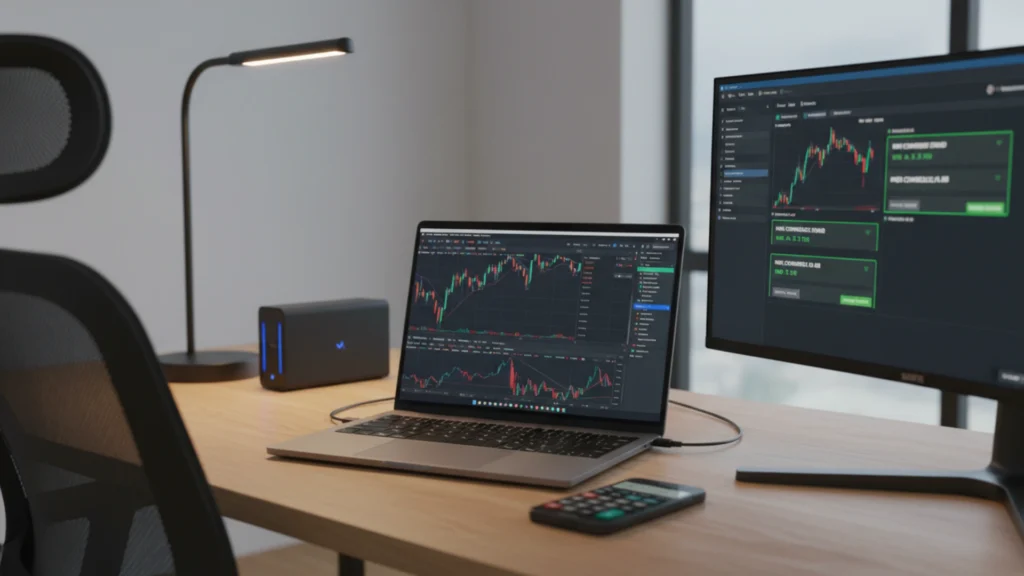
Success in arbitrage forex requires specific tools that help you spot and execute opportunities faster than competition:
Trading Platforms
You need accounts with multiple brokers that allow simultaneous trading. MetaTrader 4 and MetaTrader 5 are popular because many brokers support them, making comparison easier.
Some traders use specialized platforms designed specifically for arbitrage forex software needs. These connect to multiple brokers through one interface.
Arbitrage Scanners
These programs constantly monitor prices across different brokers and alert you when profitable gaps appear. Manual watching is nearly impossible—opportunities disappear too quickly.
Quality scanners check dozens of currency pairs across multiple platforms every second, identifying real-time forex arbitrage chances before they vanish.
Calculators
You need these forex tools that instantly calculate if a price difference is large enough to profit after spreads and fees. Speed matters—hesitating even one second can erase opportunities.
Automated forex arbitrage systems often include built-in calculators that factor in all costs automatically before executing trades.
VPS (Virtual Private Server)
Think of VPS as a super-fast computer that lives in a data center and runs 24/7. It keeps your trading software active even when your home computer is off.
Location matters for execution speed in forex arbitrage. A VPS near your broker’s servers executes trades microseconds faster, which can mean the difference between profit and loss.
Many serious arbitrage traders consider VPS essential, not optional. The monthly cost (usually $20-50) pays for itself through better execution quality.
How Much Money Do You Need to Start Forex Arbitrage?
Many beginners ask how much capital they need for arbitrage forex trading. Let’s be honest about the numbers.
Technically, you could start with $100 on some brokers. But here’s the reality: small accounts face huge disadvantages in arbitrage forex.
Price differences are tiny—usually 2-5 pips. On a $100 account trading micro lots, a 5-pip profit equals about 50 cents. After spreads and fees, you might make 20 cents per opportunity.
Finding even 10 opportunities per day would earn just $2. That’s not worth the time, tools, and effort required for successful currency arbitrage strategy execution.
Most experienced arbitrage forex traders suggest starting with at least $1,000-$5,000. This allows standard lot or mini lot trading where each pip movement creates meaningful profit.
With $5,000, a 5-pip arbitrage opportunity could generate $25-50 after costs. Catching several of these daily makes the strategy worthwhile.
Remember that you need capital split across multiple brokers. If you have $5,000 total, you might put $2,500 in Broker A and $2,500 in Broker B to execute both sides of arbitrage trades.
Institutional arbitrage forex operations run millions of dollars because their edge is incredibly small. They make money through massive volume, not large percentage gains.
Set realistic expectations based on your capital size. Arbitrage isn’t a magic money machine for tiny accounts.
Spreads, Fees, and Hidden Costs (Very Important)
This section could save you from painful losses. Understanding costs is absolutely critical in arbitrage forex because profit margins are razor-thin.
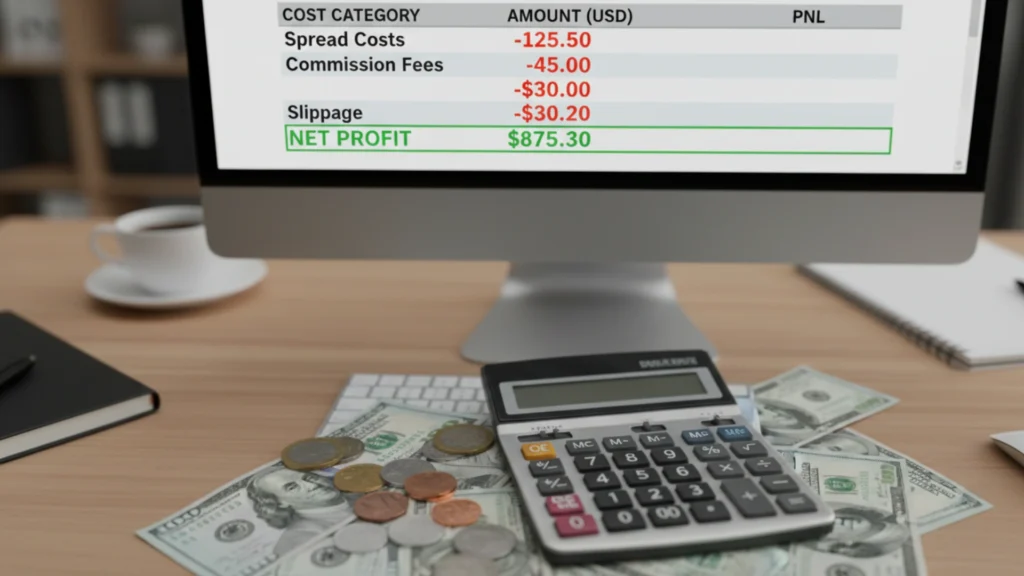
Every broker charges a spread—the difference between buy and sell price. If EUR/USD has a 2-pip spread on both brokers, you’re paying 4 pips total cost just to enter trades.
If your price discrepancy is 5 pips but costs are 4 pips, your real profit is only 1 pip. That’s hardly worth the risk and effort.
Commissions add another layer. ECN brokers often charge $3-7 per lot traded. With trades on two brokers, that’s $6-14 in commissions per round trip.
Slippage happens when your order fills at a different price than expected. In fast-moving markets, you might click “buy at 1.0850” but actually get filled at 1.0852.
Even 1-2 pips of slippage on both sides can completely erase your arbitrage profit. This makes execution speed crucial for any currency pair arbitrage strategy.
Swap fees (overnight interest) matter if positions stay open past 5 PM EST. Some brokers charge significant swap costs that eat into profits on positions held longer than intended.
Withdrawal fees also reduce profits. Some brokers charge $25-40 per withdrawal. If you’re making $50 per day in arbitrage profits, losing $40 to withdrawal fees hurts.
Always calculate total costs before executing any arbitrage opportunity. Many beginners ignore fees and wonder why they lose money despite finding price differences.
Which Brokers Allow Forex Arbitrage?
Not all brokers welcome arbitrage traders. Understanding broker types helps you choose wisely for arbitrage forex trading strategies.
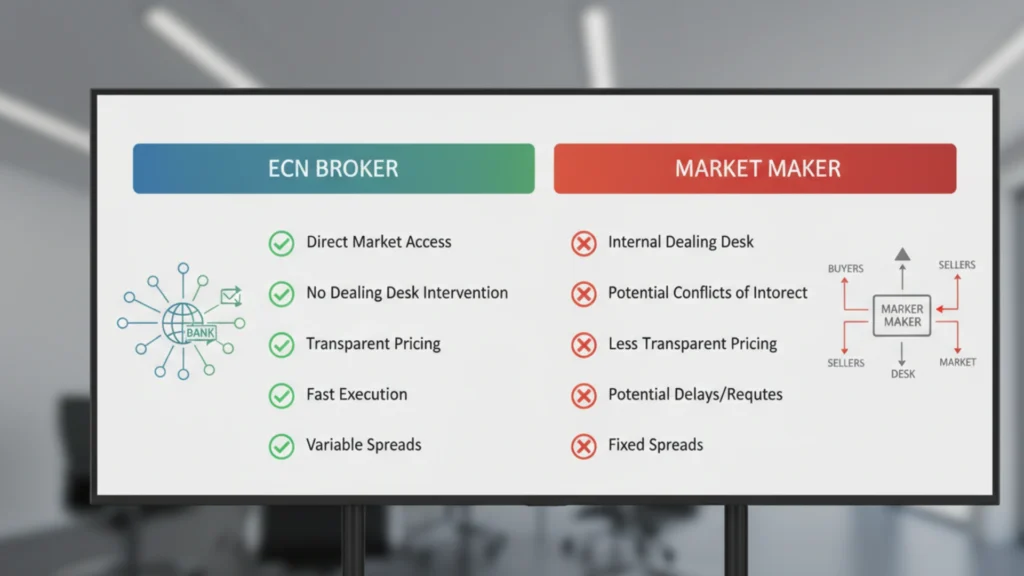
ECN vs Market Maker
ECN (Electronic Communication Network) brokers connect you directly to the interbank market. They typically allow arbitrage because they profit from commissions, not your losses.
Market maker brokers set their own prices and often take the opposite side of your trades. They usually ban arbitrage forex in their terms of service because it reduces their profit.
Why Some Brokers Ban It
Brokers that quote their own prices can lose money when you exploit their pricing errors. They see arbitrage as taking advantage of their systems rather than fair trading.
Many brokers explicitly state “no arbitrage trading” in account agreements. Violating this can result in profit deletion, account closure, or withdrawal denials.
Some brokers allow arbitrage between different currency pairs but ban it between multiple brokers using their platform. Read the fine print carefully.
What to Check Before Opening Accounts
Always read the broker’s terms of service completely. Look for phrases like “prohibited trading strategies” or “arbitrage restrictions.”
Contact customer support directly and ask: “Does your company allow arbitrage trading between multiple brokers?” Get the answer in writing via email.
Check broker reviews on forex forums. Other arbitrage traders share which companies actually allow the strategy versus those who ban accounts despite unclear policies.
Look for brokers with fast execution, low spreads, and minimal slippage. These factors matter more in arbitrage forex than fancy trading tools or bonus offers.
Consider broker regulation too. Regulated brokers in the US, UK, or Australia follow stricter rules and are less likely to unfairly close profitable accounts.
Common Forex Arbitrage Mistakes Beginners Make
Learning from others’ errors saves time and money. Here are the biggest mistakes new arbitrage traders make:
Slow Execution
Beginners try manual arbitrage—watching prices and clicking buttons themselves. By the time you spot a gap and place trades, the opportunity vanishes.
Forex arbitrage execution speed must be measured in milliseconds, not seconds. Automated forex arbitrage systems execute trades hundreds of times faster than human hands.
Ignoring Spreads
New traders see a 5-pip price difference and get excited. They forget that combined spreads might be 4-5 pips, leaving zero or negative profit.
Always subtract total costs from the price gap before deciding if an opportunity is real. Most apparent chances disappear once you account for spreads properly.
Using the Wrong Broker
Opening accounts with market makers that ban arbitrage is a recipe for account closure. Your first few profitable trades might work, then suddenly your account gets restricted.
Do research upfront. Only use brokers that explicitly allow arbitrage forex or have strong reputations for permitting all legal trading strategies.
Over-Leveraging
Some traders use maximum leverage thinking arbitrage is risk-free. They forget about execution risk—what happens if one trade fills but the other doesn’t?
If your buy order fills but the sell order fails, you’re left with a directional position that could lose money. Conservative leverage protects you when technology fails.
Not Testing First
Jumping into live trading without testing systems on demo accounts is dangerous. Demo testing reveals execution speeds, spread costs, and platform reliability before risking real money.
Spend at least 2-3 weeks practicing any currency arbitrage strategy on demo accounts. Track every trade, calculate actual costs, and ensure consistent profitability before going live.

Is Arbitrage Forex Safe?
Let’s address safety honestly without sugar-coating or fear-mongering about arbitrage forex.
The strategy itself carries less market risk than directional trading because you’re not betting on price movement. Both sides of your trade protect each other.
However, execution risk is real. Technology failures, internet disconnections, or platform crashes can leave you with unmatched positions that lose money.
Broker risk exists too. Even if arbitrage is technically legal, brokers can close accounts, delay withdrawals, or claim you violated unclear terms of service.
Regulatory risk matters in some countries. While forex arbitrage trading is legal in most places, some jurisdictions restrict certain trading strategies or broker types.
Capital risk comes from fees and costs. If your strategy isn’t genuinely profitable after all expenses, you’ll slowly lose money despite winning individual trades.
Competition risk grows constantly. More traders using automated forex arbitrage systems mean opportunities become scarcer and disappear faster.
The “risk-free forex arbitrage” label is misleading. Lower risk than directional trading? Yes. Completely risk-free? No.
Think of it like driving a car carefully versus recklessly. Careful driving is safer than speeding, but accidents can still happen even when you follow all rules.
With proper tools, reliable brokers, realistic expectations, and good risk management, arbitrage forex can be relatively safe. But “safe” doesn’t mean “guaranteed profits with zero risk.”
Who Should Avoid Forex Arbitrage Trading
Honesty about who this strategy fits helps everyone. Arbitrage forex isn’t for everyone, and that’s perfectly okay.
Beginners Without Tools
If you’re brand new to forex and don’t have forex arbitrage software, scanners, or VPS setup, this strategy will frustrate you.
Start with learning basic forex concepts first. Understand how currency pairs work, what spreads are, and how brokers operate before attempting arbitrage.
Traders With Small Capital
If you have less than $1,000 to invest across multiple broker accounts, your returns won’t justify the effort required for successful currency arbitrage strategy execution.
The math simply doesn’t work with tiny accounts. Focus on building capital through other methods before exploring arbitrage opportunities.
Those Expecting Easy Money
Some people hear “risk-free” and imagine printing money without effort. Real arbitrage forex requires constant monitoring, fast technology, and significant upfront investment in tools.
It’s technical, detail-oriented work that demands precision. If you want passive income or get-rich-quick schemes, look elsewhere.
People Without Technical Skills
Setting up VPS servers, connecting multiple broker platforms, configuring arbitrage scanners, and troubleshooting technical issues requires computer literacy.
If technology frustrates you or you struggle with software setup, retail forex arbitrage trading will create more headaches than profits.
Impatient Personalities
Arbitrage involves lots of small wins adding up over time. You might execute 50 trades to make $200. If you need excitement and big wins, this grinding style won’t satisfy you.
Know yourself honestly. There’s no shame in recognizing that forex arbitrage trading strategies don’t match your personality, skills, or financial situation.

Can Retail Traders Really Compete With Big Firms?
This question deserves a straight answer about institutional forex arbitrage versus what retail traders can achieve.
Big financial institutions have enormous advantages. They operate with millions or billions of dollars, getting better spreads and lower fees than retail traders ever will.
Their technology costs millions. Direct market access, co-located servers next to exchange data centers, and custom-built forex arbitrage bots operate at speeds retail traders cannot match.
High-frequency forex arbitrage dominated by institutions happens in microseconds. They capture opportunities so fast that retail traders never even see them appear.
However, retail traders aren’t completely locked out. Different types of opportunities exist at different speed levels.
Ultra-fast latency arbitrage? You can’t compete. But slower broker arbitrage opportunities that last several seconds? These are still accessible to well-prepared retail traders.
Institutions ignore tiny profit amounts that matter to individuals. A $50 profit per trade means nothing to a bank but could be meaningful passive income for someone with a $10,000 account.
Some retail traders succeed by focusing on less competitive niches like swap arbitrage or specific exotic currency pairs that big institutions ignore.
The honest truth: you won’t beat institutional players at their own game. But you can find different games where your advantages—flexibility, lower overhead, and smaller profit needs—create viable opportunities.
Competition has definitely increased. Profit from forex arbitrage opportunities today is harder than it was 10 years ago. But “harder” doesn’t mean “impossible” for dedicated retail traders with proper tools and realistic expectations.
Is Forex Arbitrage Still Profitable in 2025 and Beyond?
Looking at the future of arbitrage forex requires examining current trends and likely developments.
Automation Growth
More traders now use automated arbitrage forex systems than ever before. This increases competition for every opportunity, making gaps smaller and shorter-lived.
As technology improves and becomes cheaper, even more traders will adopt automation. This trend will likely continue, further compressing profit margins.
Broker Restrictions
Many brokers have tightened policies against certain arbitrage methods, especially latency arbitrage forex tactics. Terms of service increasingly include anti-arbitrage clauses.
This trend will probably continue as brokers protect themselves from strategies they consider exploitative. Finding arbitrage-friendly brokers may become harder.
Competition Increase
Every year, more sophisticated traders enter the market with better tools. Statistical arbitrage forex methods using AI and machine learning are becoming more common.
The edge that simple broker arbitrage provided in 2015 has shrunk significantly by 2025. Future years will likely see even more competition.
Regulatory Changes
Some regulators might introduce rules affecting high-frequency trading or certain arbitrage methods. While unlikely to ban the practice entirely, new regulations could create additional compliance costs.
Technology Advances
Better internet speeds and cheaper VPS hosting help retail traders. Cloud computing makes powerful tools more accessible than ever before.
Blockchain and decentralized finance might create new types of forex arbitrage opportunities today that didn’t exist previously.
Realistic Outlook
Will arbitrage forex remain profitable in 2025 and beyond? Yes, but with shrinking margins and higher requirements.
Successful traders will need better technology, more capital, and greater sophistication than predecessors. The “easy era” of arbitrage has passed.
However, as long as markets have multiple participants and information takes time to spread, some form of arbitrage will always exist. The question isn’t whether opportunities exist—it’s whether you can capture them profitably given your resources.
Low-risk forex trading methods like arbitrage will continue attracting traders seeking alternatives to directional speculation. That demand ensures the strategy remains relevant even as competition intensifies.

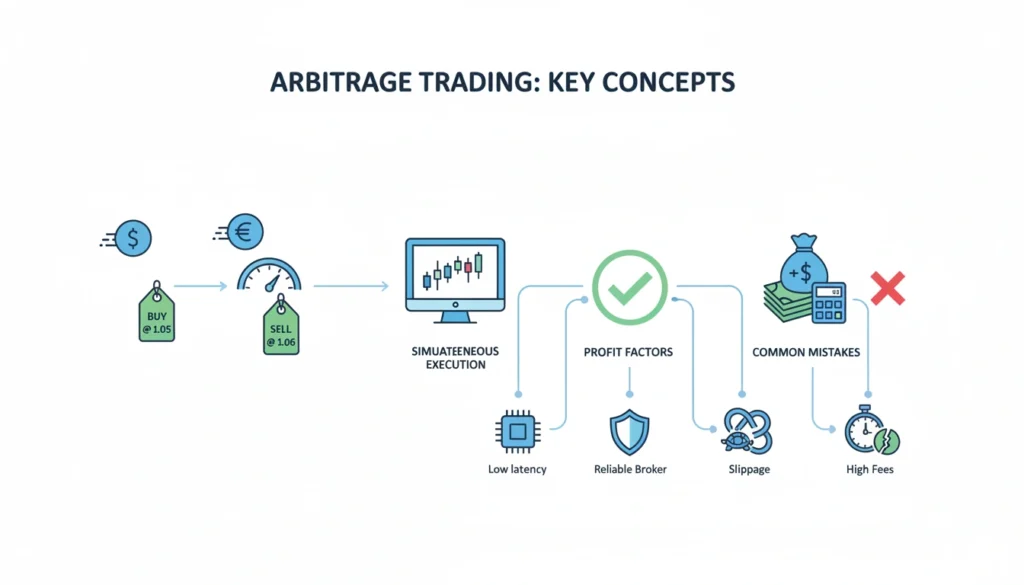
Arbitrage Forex: Key Takeaways (Simple Summary)
Let’s recap everything in simple points anyone can understand:
- Arbitrage forex means buying and selling the same currency at different prices to catch the gap
- It’s different from normal trading because you don’t guess price direction—you spot existing differences
- Price gaps exist because of broker differences, speed delays, and market inefficiencies
- Main types include triangular arbitrage, broker arbitrage, swap arbitrage, and latency arbitrage
- You need special tools: trading platforms, scanners, calculators, and VPS for speed
- Small accounts struggle because profit per trade is tiny—start with at least $1,000-$5,000
- Spreads and fees can erase profits, so always calculate total costs before trading
- Choose ECN brokers that allow arbitrage; avoid market makers that ban the strategy
- Common mistakes include slow execution, ignoring costs, and using wrong brokers
- It’s lower risk than directional trading but not completely risk-free
- Beginners without tools, people with small capital, and those wanting easy money should avoid it
- Retail traders can compete but not at the ultra-high-frequency level of big institutions
- The strategy remains profitable in 2025 but with tighter margins and more competition
- Success requires realistic expectations, proper tools, sufficient capital, and continuous learning
Beginner FAQ (Short & Clear)
Is it legal?
Yes, forex arbitrage trading is legal in most countries. However, some brokers ban it in their terms of service. Always check broker rules before trading. The strategy itself isn’t illegal—it’s about whether specific brokers allow it.
Is it guaranteed profit?
No. While often called “risk-free forex arbitrage,” execution problems, fees, and technical failures can cause losses. Profit margins are small, and costs can exceed gains. It’s lower risk, not zero risk.
Can I automate it?
Yes. In fact, automation is almost essential. Manual trading is too slow to catch opportunities before they disappear. Most successful arbitrage traders use forex arbitrage software or automated systems to scan and execute trades.
Can I lose money?
Yes. If one trade fills but the other doesn’t, you’re left with market risk. High spreads and fees can turn profits into losses. Broker account closures can trap funds. Technology failures create unmatched positions. Capital management matters greatly.
How fast must I execute trades?
Very fast—usually within 1-3 seconds for broker arbitrage, and milliseconds for high-frequency methods. This is why automated forex arbitrage bots are necessary. Human reaction time simply can’t compete with modern market speeds.
Do I need accounts with multiple brokers?
For broker price arbitrage, yes. You need at least two brokers showing different prices. For triangular arbitrage forex, you might only need one broker with multiple currency pairs available.

Final Word:
Arbitrage forex offers a unique approach to currency markets that differs from traditional trading. While it sounds appealing in theory, success requires significant preparation, proper tools, adequate capital, and realistic expectations. If you have the resources and technical ability, it can become part of a diversified trading strategy. But remember—no trading method eliminates risk entirely. Always trade responsibly and never risk money you cannot afford to lose.
