
Imagine you’re watching a game where one team is winning for a long time. Suddenly, the other team starts scoring and takes control. That’s exactly what happens in forex trading when we see a change of character.
Change of character in forex trading, or Change of Character, is like a warning sign that tells traders the market might be changing direction.
When buyers have been pushing the price up for a while, and suddenly sellers start taking control, that’s a change of character.
Traders love this concept because it helps them spot trend changes early, before most people notice.
Instead of waiting until the trend has completely reversed, smart traders use CHoCH to get in at better prices and avoid getting trapped in old trends that are ending.
How Price Moves in the Forex Market (Very Simple)
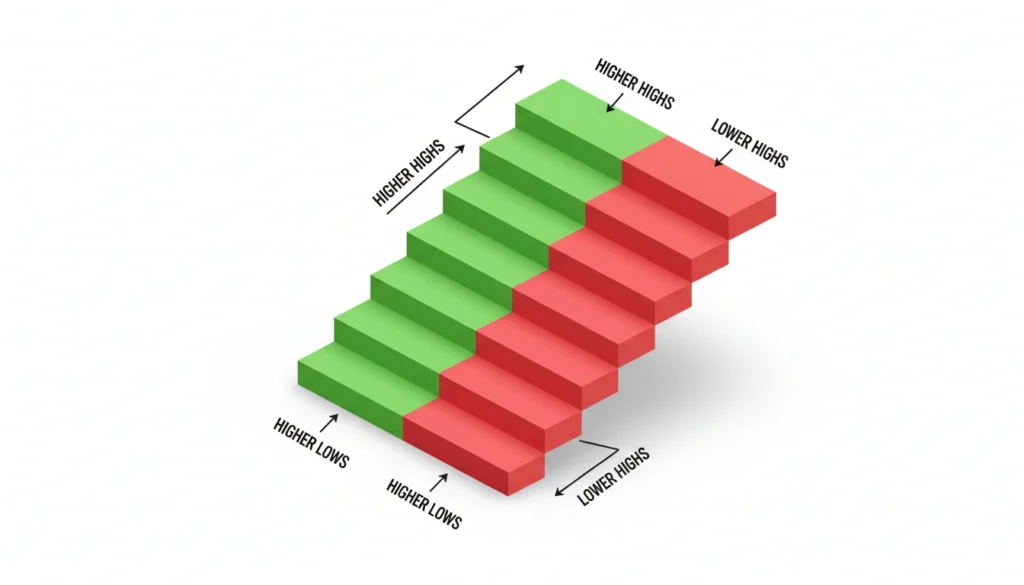
Think of price movement like a staircase. When you walk up stairs, you go up, then maybe rest a bit, then up again. That’s how price moves when it’s going upward in forex.
Every time price goes up and makes a new high point, then pulls back a little, then goes up again to make an even higher point, we call this an uptrend.
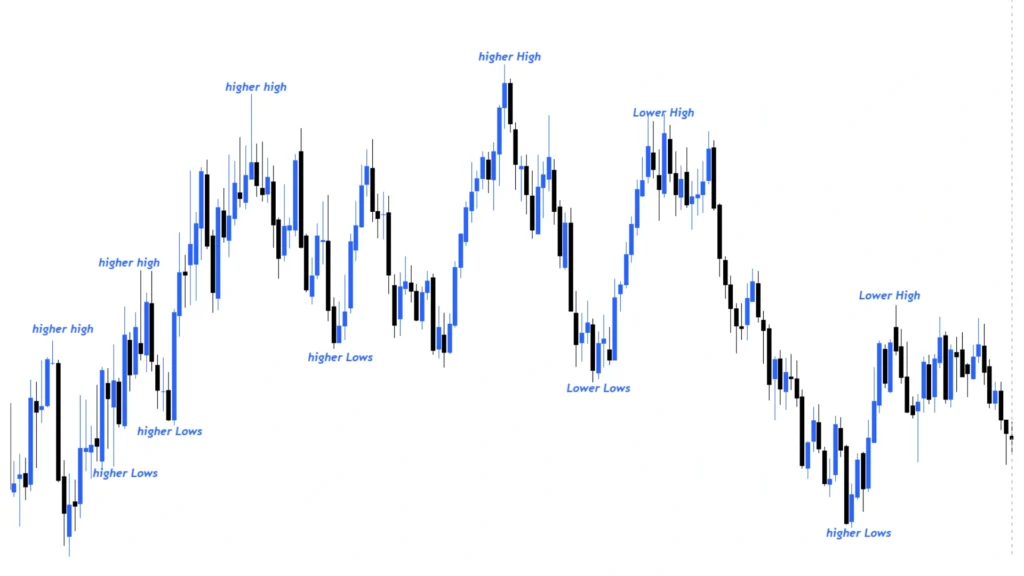
The high points are called “highs” and the low points where it rests are called “lows.” In an uptrend, each new high is higher than the last one, and each new low is also higher than the previous low.
It’s like climbing stairs where each step is a bit higher.
Now, a downtrend is the opposite. It’s like walking down stairs. Price makes a low point, bounces up a little, then makes an even lower low point.
Each high is lower than the previous high, and each low is lower than the previous low.
Understanding this simple staircase pattern is super important because change of character happens when these stairs start going the opposite direction.
What Is Market Structure in Forex?
Market structure is simply the pattern that price makes as it moves up and down. Think of it like footprints in the sand. When someone walks, their footprints show which direction they went.
In forex, the market leaves “footprints” too. These footprints are the highs and lows we talked about earlier.
When we connect these highs and lows, we can see if the market is walking upward (uptrend), walking downward (downtrend), or just wandering around without clear direction (ranging).
Before you can understand change of character forex concepts, you need to see these footprints clearly. Market structure change forex happens when these footprints suddenly change direction.
It’s like someone walking north who suddenly turns around and starts walking south. That change in the footprint pattern is what we’re looking for.
What Is Change of Character (CHoCH) in Forex Trading?
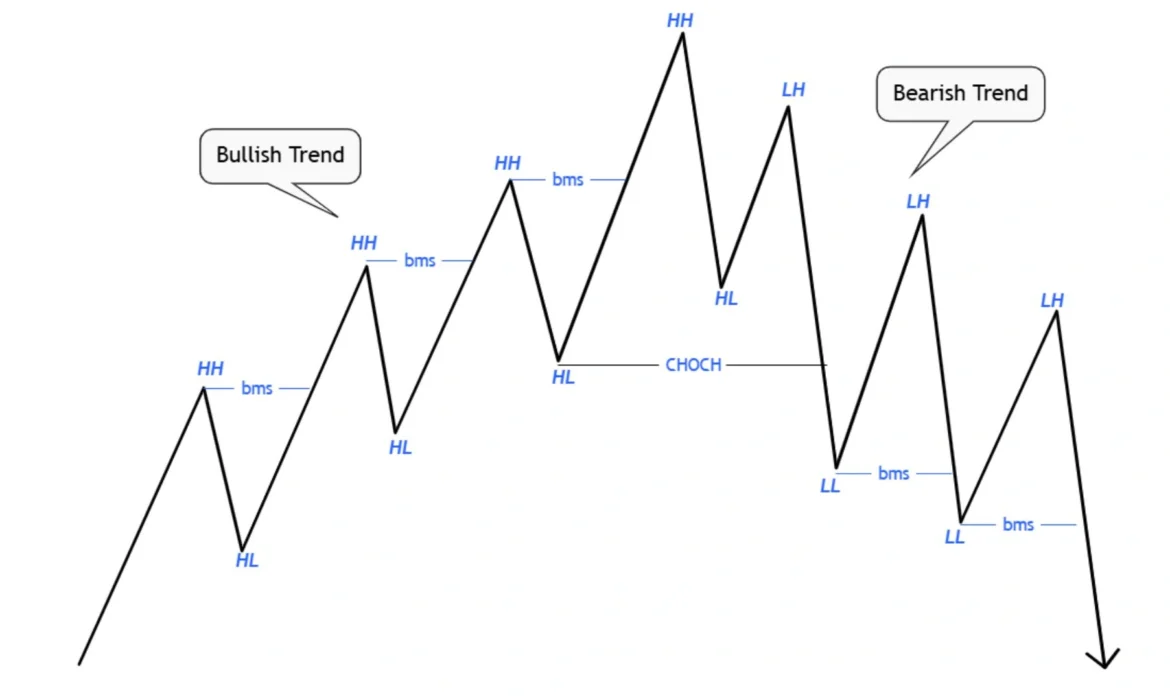
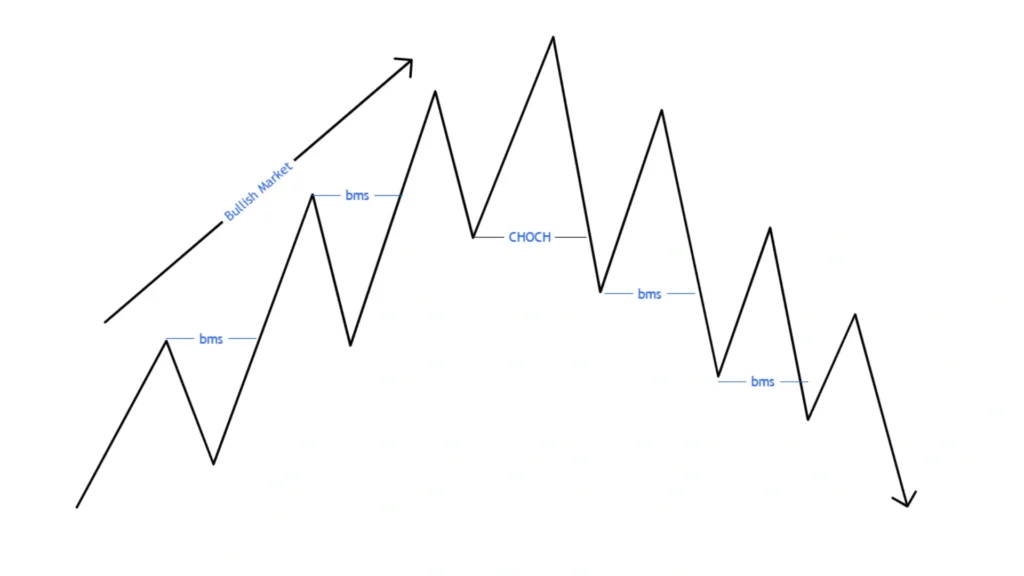
A change of character in forex trading is the exact moment when the market structure breaks in a way that suggests the trend might be reversing. Let me make this super simple.
Imagine price has been making higher highs and higher lows (going up like stairs). A CHoCH happens when price breaks below a previous higher low.
This is important because it means the upward staircase pattern is broken. The market’s “character” has changed.
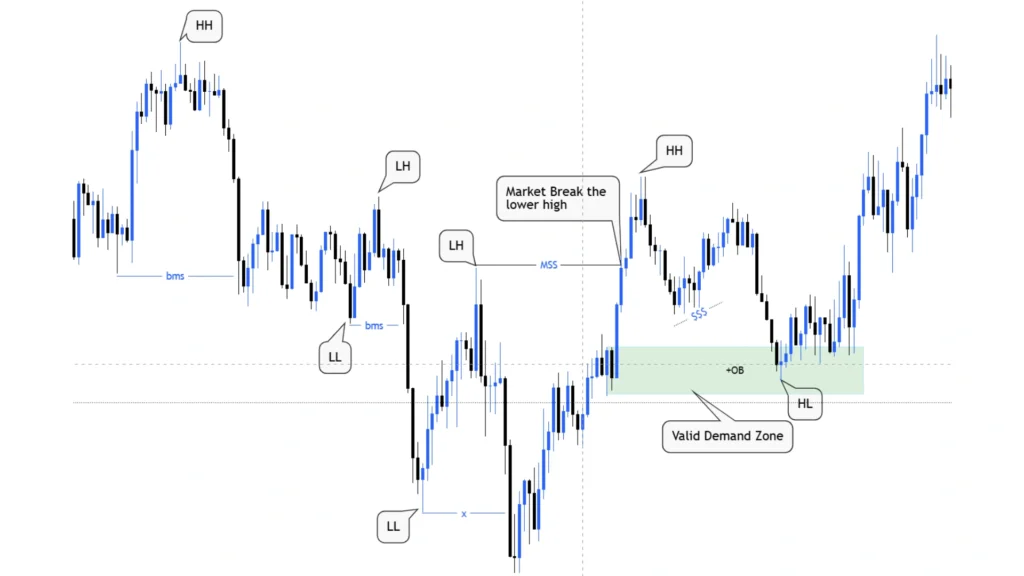
It’s no longer behaving like a healthy uptrend. Similarly, in a downtrend, CHoCH occurs when price breaks above a previous lower high.
The forex change of character strategy is all about catching this exact moment when the old trend’s structure breaks.
This gives traders an early warning that the trend might be changing direction, allowing them to prepare for new opportunities or protect their existing trades.
Why Is It Called a Change of Character?
Think about a person’s character or personality. When someone is usually happy and suddenly becomes sad, we notice the change in their character or mood, right?
The market has a character too.
When buyers are in control, the market’s character is bullish—it wants to go up. It acts happy and energetic, making higher highs and higher lows.
When sellers are in control, the market’s character is bearish—it wants to go down. It acts heavy and weak, making lower lows and lower highs.
A change of character happens when this personality shift occurs. The market was acting like buyers were in charge, but suddenly it starts acting like sellers are taking over. Or vice versa.
This change in behavior, this shift from one personality to another, is why we call it a “change of character.” It’s the market telling us, “Hey, I’m not the same anymore. I’m changing my behavior.”
The Theory Behind Change of Character (Smart Money View)
Big banks, institutions, and professional traders (we call them “smart money”) move huge amounts of money in the forex market.
They can’t just buy or sell whenever they want because their orders are so big.
Here’s what they do: First, they let the regular traders (retail traders like beginners) think the trend is continuing. While everyone is buying in an uptrend, smart money is actually preparing to sell.
They need all those buyers so they have someone to sell to. Once enough regular traders are trapped in the wrong direction, smart money makes their move.
This creates the smart money change of character. The price suddenly breaks the structure because big players just entered in the opposite direction with massive orders.
Understanding this helps explain why change of character forex setups work. We’re essentially watching for signs that institutional market structure forex is shifting, that the big players are changing their position.

Break of Structure (BoS) Explained Simply
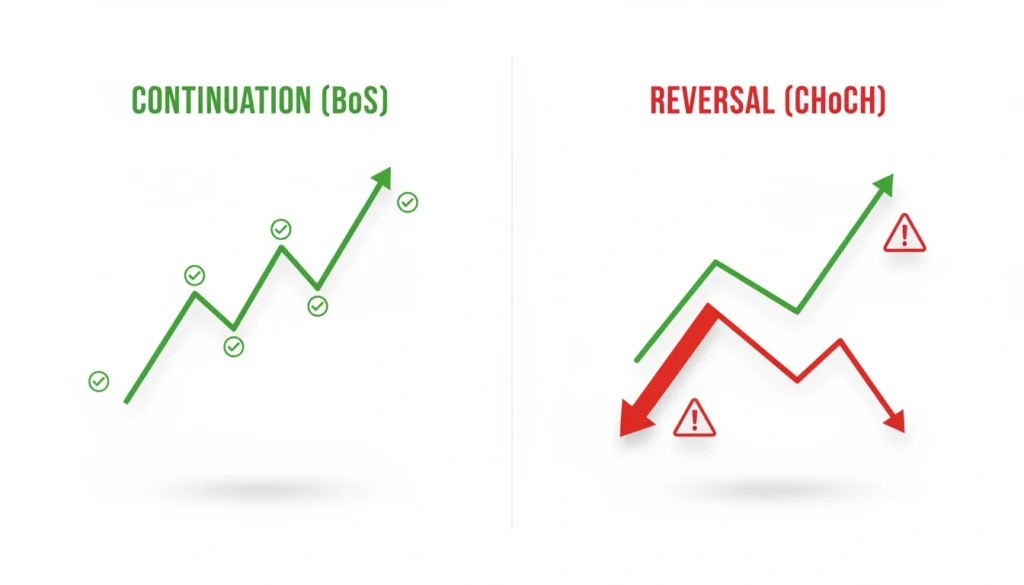
While CHoCH signals a possible reversal, Break of Structure (BoS) signals continuation. Let me explain the difference clearly.
When you’re in an uptrend and price keeps making higher highs, each time it makes a new higher high, that’s a Break of Structure upward.
It means the trend is continuing strong. The market is saying, “I’m still going up, everything is fine.” In a downtrend, when price makes a new lower low, that’s a BoS downward, confirming the downtrend is still in control.
Think of BoS like a green light that says “keep going, the trend is healthy.” The market structure is breaking in the direction of the existing trend, which is good news if you’re already in that trade.
Understanding BoS helps you stay in good trades longer instead of exiting too early.
Change of Character vs Break of Structure (CHoCH vs BoS)
This is where many traders get confused, so let’s make it crystal clear with a simple rule.
CHoCH vs break of structure comes down to one thing: direction.
CHoCH breaks structure AGAINST the current trend (possible reversal), while BoS breaks structure WITH the current trend (continuation).
In an uptrend, if price breaks below the previous higher low, that’s CHoCH (warning sign). If price breaks above the previous higher high, that’s BoS (continuation signal).
In a downtrend, breaking above the previous lower high is CHoCH, while breaking below the previous lower low is BoS.
Remember this: BoS = trend continues (good), CHoCH = trend might reverse (warning). This simple distinction is crucial for the change of character trading concept and knowing whether to stay in trades or prepare for reversals.
Change of Character vs Market Structure Shift (MSS)
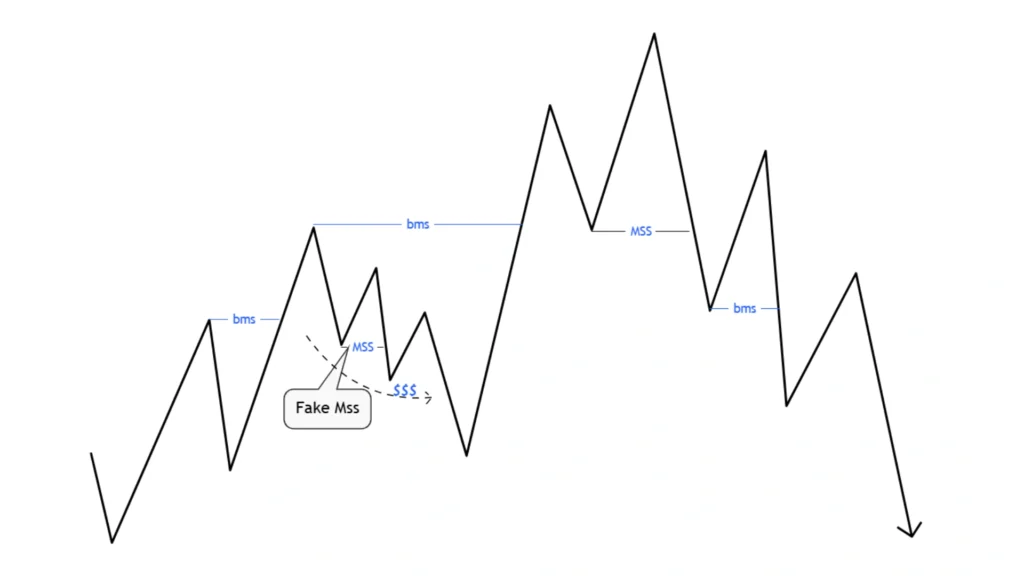
Many traders use CHoCH and MSS (Market Structure Shift) interchangeably, but technically they’re describing the same thing from different perspectives.
Some traders say “change of character” while others say “market structure shift.” Both terms mean the market structure has broken in a way that suggests a possible reversal.
The confusion happens because different educators use different names for the same concept. In practical trading, what matters is recognizing when the structure breaks against the trend.
Whether you call it CHoCH or MSS doesn’t change what you’re looking for on the chart. Don’t let terminology confuse you.
Focus on understanding the concept: when an uptrend breaks below a previous low, or when a downtrend breaks above a previous high, that’s your signal.
The name is less important than recognizing the pattern and what it means for your trading decisions.
Internal vs External Highs and Lows (Important Concept)
Not all highs and lows are created equal, and this is a game-changer for improving your change of character accuracy.
External highs and lows are the obvious ones—the big turning points that are clearly visible. Internal highs and lows are smaller swings that happen inside the bigger moves.
Think of external points as the big peaks and valleys you’d see from far away, and internal points as the smaller bumps you’d only notice if you looked closely.
For reliable CHoCH signals, you should focus on external structure, not internal. If you mark every tiny movement as a high or low, you’ll see fake CHoCH signals everywhere and get confused.
Experienced traders learn to filter out the noise and focus on significant structure points. This is why the same chart can look completely different to a beginner versus a professional—they’re seeing different structural levels.
Types of Change of Character in Forex Trading
Bullish Change of Character
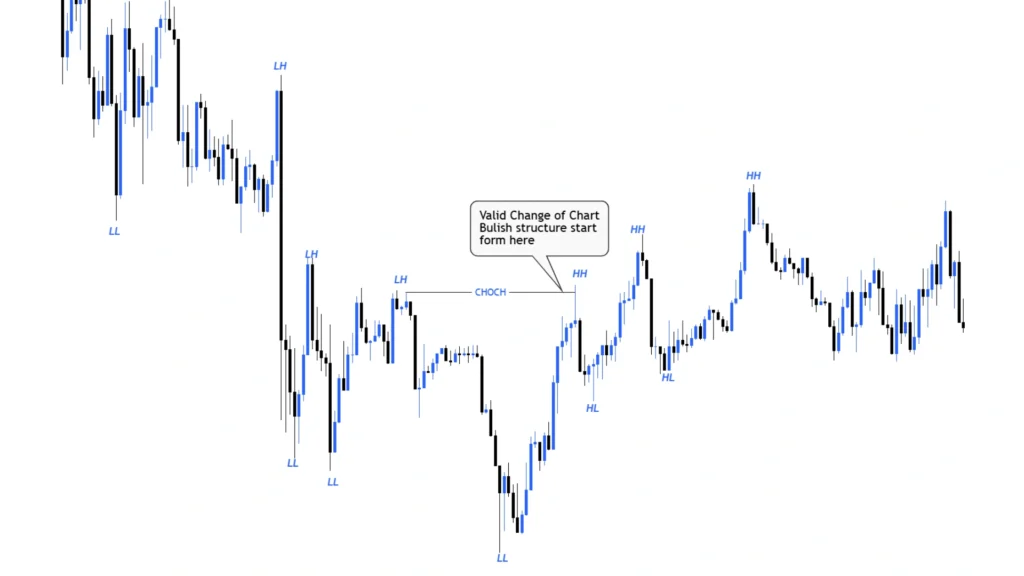
A bullish change of character happens when sellers have been in control, pushing price down, but suddenly lose their power and buyers take over.
Picture a downtrend where price is making lower lows and lower highs like steps going downward. Everything looks bearish.
Then something happens: price breaks above a previous lower high. This break is important because it means the downward staircase is broken.
Sellers tried to push price down again but couldn’t. Buyers stepped in with enough force to break the structure. This is your bullish change of character signal.
It doesn’t guarantee price will go up forever, but it’s a strong warning that the downtrend might be ending and an uptrend might be starting.
Traders who recognize this early can position themselves for the potential upward move before most people notice the trend change.
Bearish Change of Character
A bearish change of character is the opposite. It happens when buyers have been in control, but suddenly sellers take over and break the upward structure.
Imagine an uptrend with price making beautiful higher highs and higher lows, climbing like stairs. Everyone is excited, thinking the uptrend will continue forever.
Then price breaks below a previous higher low. This is significant because the upward staircase pattern just broke. Buyers tried to keep pushing up but failed.
Sellers came in strong enough to break the structure. This bearish CHoCH warns that the uptrend might be ending.
Smart traders use this signal to either take profits on their long trades, avoid entering new long positions, or prepare for potential short (sell) opportunities.
Recognizing bearish change of character early helps protect your account from being caught in a reversing trend.
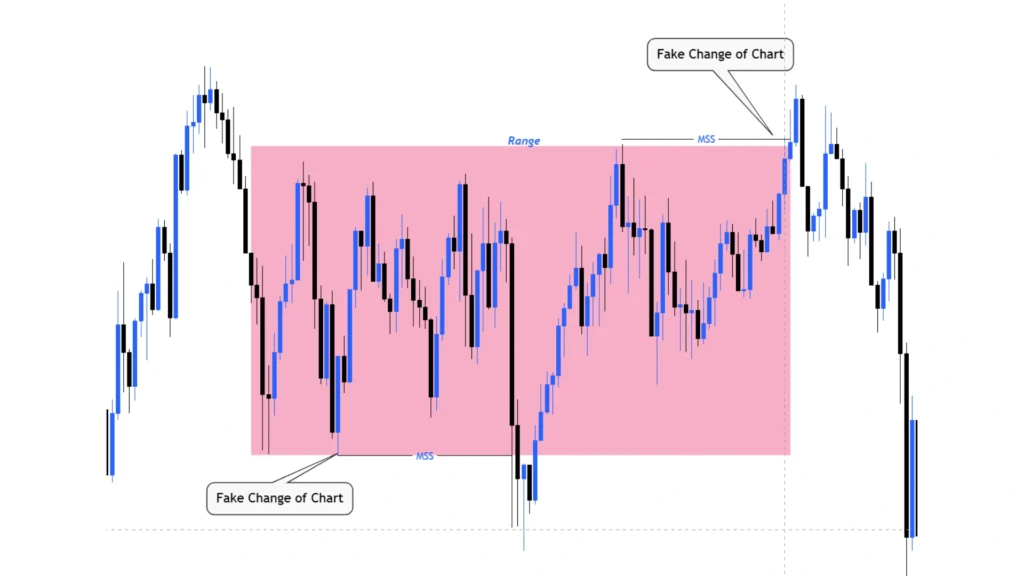
Fake Change of Character
Not every CHoCH leads to a real trend reversal, and this is where many traders lose money. Fake change of character setups are SMC traps.
Sometimes price will break structure, make everyone think the trend is reversing, then quickly return to the original trend direction.
This happens especially in ranging markets or when big players are manipulating price to trigger stop losses.
A fake CHoCH might break a low or high by just a few pips, grab liquidity (stop hunters at work), then reverse immediately.
This is why confirmation is so important. Just seeing a structure break isn’t enough. You need additional evidence like strong momentum, order block reactions, or higher timeframe alignment.
Traders who jump into every CHoCH without confirmation get trapped repeatedly. Patience and waiting for proper validation separate successful traders from those who keep losing on false signals.

How to Identify a Change of Character on a Price Chart
Let me give you a simple step-by-step process to spot CHoCH visually on any chart, even if you’re a complete beginner.
First, zoom out and identify the current trend. Is price making higher highs and higher lows (uptrend) or lower highs and lower lows (downtrend)? Second, mark the most recent significant high and low points.
Don’t mark every tiny movement—focus on the obvious turning points. Third, watch what price does next. In an uptrend, you’re watching to see if price breaks below the most recent higher low.
In a downtrend, you’re watching to see if price breaks above the most recent lower high. Fourth, when that break happens, mark it as a potential CHoCH.
Draw a horizontal line at that broken level so you can see it clearly. Finally, wait for price to close beyond that level, not just touch it briefly.
A proper break means the candle fully closes on the other side. This visual process, when practiced repeatedly, becomes automatic and helps you catch change of character in forex trading setups in real-time.
How to Confirm a Real CHoCH (Avoid Fake Signals)
Spotting a CHoCH is one thing; confirming it’s real and not a fake is what separates profitable traders from struggling ones.
Here’s your simple confirmation checklist: First, check if the CHoCH happened with strong momentum (big candles, not small hesitant ones).
Second, see if price pulled back to an order block or imbalance area and rejected from there—this shows institutional involvement.
Third, check the higher timeframe to ensure it agrees with your CHoCH signal; never trade against higher timeframe structure.
Fourth, wait for price to retest the broken level and hold—if it breaks back immediately, it’s likely fake.
Fifth, look for volume increase if you have volume data; real CHoCH usually comes with higher volume.
Not every CHoCH will show all these confirmations, but the more boxes you can check, the higher your probability of success. Patience in waiting for confirmation is the price you pay for avoiding false signals and protecting your capital.
Best Timeframe for Change of Character in Forex Trading
Choosing the right timeframe can make the difference between consistent profits and constant confusion in your CHoCH trading.
For beginners, the 1-hour and 4-hour timeframes work best. Why? Because they filter out a lot of the noise and fake moves you see on smaller timeframes like 1-minute or 5-minute charts.
On the 1-hour chart, you can clearly see market structure without getting overwhelmed by every tiny price movement.
The 4-hour chart is even cleaner and shows stronger, more reliable structure. Day traders might use 15-minute or 30-minute charts, but they need more experience to filter fake signals.
Swing traders often use 4-hour and daily charts for the clearest picture. As you gain experience, you can adjust timeframes based on your trading style.
But if you’re just starting with change of character forex trading, stick to 1-hour or 4-hour charts until you consistently recognize valid structure and CHoCH setups.
Multi-Timeframe Importance of CHoCH
Understanding how different timeframes work together is like having a superpower in forex trading that most beginners don’t know about.
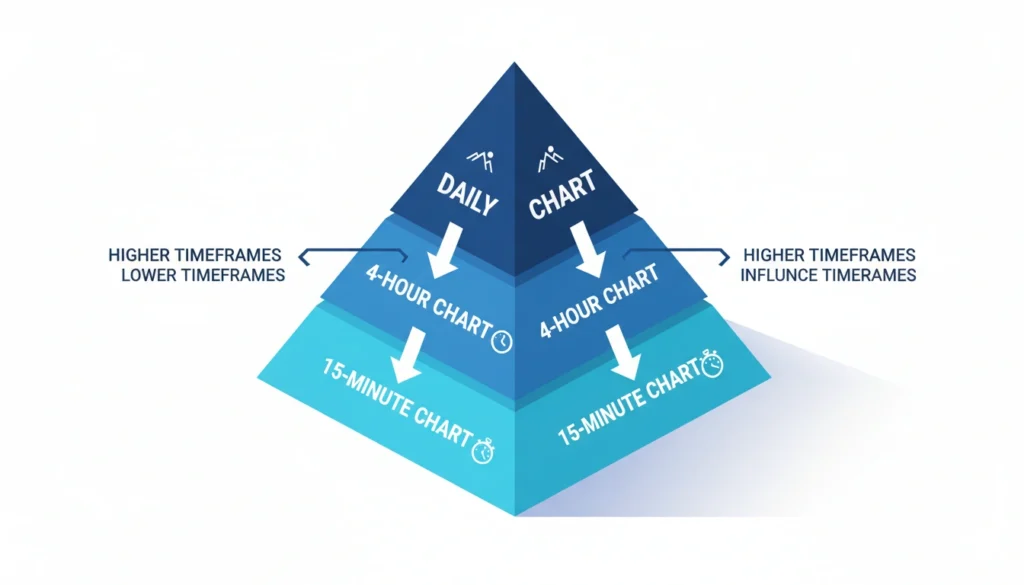
Here’s the secret: a CHoCH on a higher timeframe (like 4-hour or daily) is much more powerful than a CHoCH on a lower timeframe (like 5-minute).
Think of it like this: the daily chart is the boss, the 4-hour chart is the manager, and the 15-minute chart is the employee.
The employee can’t overrule the boss. If the daily chart shows a strong uptrend, a CHoCH on the 5-minute chart won’t change that—it might just be a small pullback.
But if the daily chart itself shows a CHoCH, that’s a major signal affecting all lower timeframes. Smart traders check higher timeframes first to see the big picture, then drop to lower timeframes to find precise entry points.
This multi-timeframe approach dramatically improves your success rate because you’re trading with the bigger forces, not against them.
Change of Character and Liquidity (Explained Like You’re 7)
Liquidity is just a fancy word for “stop losses.” Let me explain why price often grabs liquidity before showing a real CHoCH.
Imagine you and your friends are playing hide and seek. Before you start seeking, you want to make sure everyone is hiding first, right?
The forex market does something similar. Before making a big move, it often “hunts” for stop losses. Many traders place their stop losses at obvious levels, like just below a recent low in an uptrend.
Smart money knows this. So before creating a real CHoCH and reversing the trend, they push price briefly to those stop loss levels, trigger everyone’s stops (grabbing liquidity), and THEN reverse in the intended direction.
This is why you often see price make a quick spike below a level, grab stops, then shoot back up for a real bullish CHoCH.
Understanding liquidity grab and change of character together helps you avoid getting stopped out right before the market goes in your anticipated direction.
Role of Order Blocks and Imbalances in CHoCH
After a CHoCH happens, price doesn’t just run forever. It usually comes back to test specific areas before continuing. These areas are called order blocks and imbalances.
An order block is where smart money placed their last orders before the trend changed. Think of it as the place where big players made their move.
After a CHoCH, price often pulls back to retest this area. Why? Because more smart money wants to enter at the same level, or early traders want to add to their positions.
An imbalance (or fair value gap) is an area where price moved so fast that it left a gap on the chart—not enough trading happened there.
Price often returns to “fill” these gaps. When you combine order block with change of character, you get high-probability entries.
The CHoCH tells you the trend might be reversing, and the order block or imbalance tells you where to enter with good risk-reward. This is how professional traders find precise entry points instead of just guessing.
How to Trade Change of Character in Forex (Step-by-Step)
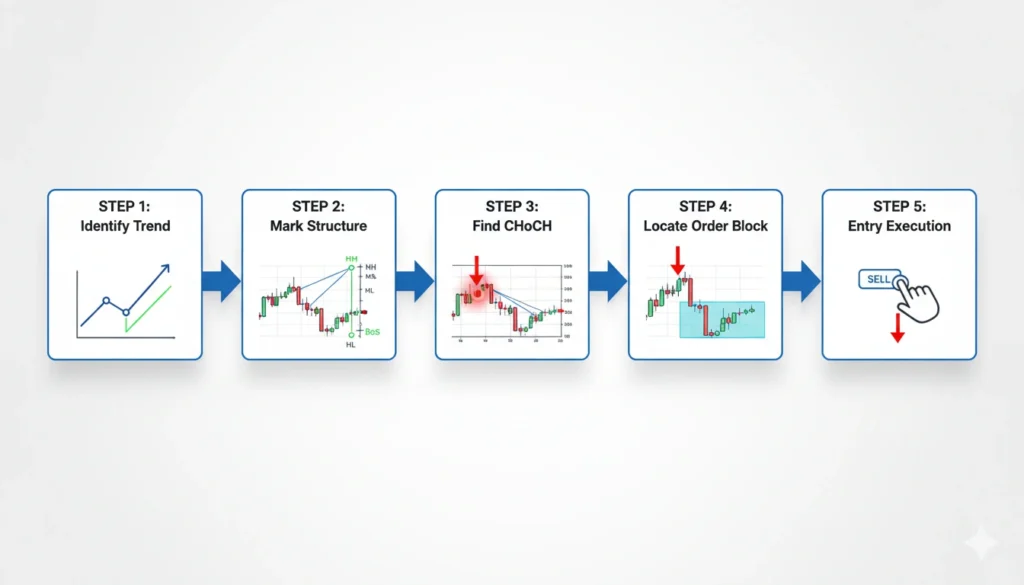
Step 1 – Identify the Trend
Before you can spot a change of character, you must know what the current trend is. Open your chart and zoom out to see the bigger picture clearly.
Is price making higher highs and higher lows? That’s an uptrend. Is it making lower highs and lower lows? That’s a downtrend.
Is it bouncing between the same high and low levels without clear direction? That’s ranging, and you should wait.
You can only identify a CHoCH if you first know what trend might be changing. This might seem obvious, but many traders skip this step and get confused.
Spend time simply observing how price moves. Draw trend lines connecting the highs or lows if it helps you visualize the trend. Once you’re confident about the trend direction, you’re ready for step two.
Step 2 – Mark Key Highs and Lows
Now that you know the trend, mark the important structural points on your chart. These are your reference points for identifying CHoCH.
Use horizontal lines or small marks to highlight the most recent significant higher high and higher low in an uptrend, or lower high and lower low in a downtrend.
Don’t mark every single tiny movement—focus on the obvious swings that are clearly visible. These marks will serve as your alert levels.
When price approaches these levels, you’ll pay closer attention. Some traders use different colors for highs (maybe red) and lows (maybe green) to make them stand out.
The goal is to have a clean chart that clearly shows you where structure could potentially break.
Step 3 – Wait for CHoCH
This is where patience becomes your greatest asset. You’ve identified the trend and marked key levels. Now you wait for price to break structure.
In an uptrend, you’re waiting for price to break below your marked higher low. In a downtrend, you’re waiting for price to break above your marked lower high.
Don’t predict or guess when this will happen. Let the market show you. Some traders wait days or even weeks for proper CHoCH setups because they refuse to force trades.
When that break happens and a candle closes beyond your marked level, that’s your potential CHoCH. But don’t jump in yet—you need confirmation first.
Step 4 – Look for Confirmation
This is the step that protects your money. A structure break alone isn’t enough to enter a trade—you need additional confirmation signals.
Check if the break happened with strong momentum (larger candles showing conviction). Look for a pullback to an order block or imbalance—this is often where you’ll enter.
Check your higher timeframe to ensure it supports this CHoCH. Wait for price behavior at the order block—you want to see rejection (the price bounces from that area).
The more confirmation signals align, the better your setup. If price breaks structure weakly with small candles and no clear order block to test, skip that trade.
There will always be another opportunity. Quality over quantity is the rule with the change of character entry model.
Step 5 – Plan Entry
Once you have confirmation, it’s time to plan your exact entry, stop loss, and take profit before placing the trade.
Your entry is typically at the order block or imbalance after the CHoCH, when price shows rejection. Your stop loss goes just beyond the order block—if price fully breaks through it, your idea is wrong and you exit.
Your take profit can be at the next significant structural level in your anticipated direction, or at a previous high/low that price might target.
Calculate your risk-reward ratio before entering. If you’re risking $100, you should aim to make at least $200 or more.
A good rule is minimum 1:2 risk-reward ratio. Write down your plan, then execute it exactly. No changing your mind mid-trade based on emotions.
Stop Loss and Take Profit in CHoCH Trades
Knowing where to place your stop loss and take profit is just as important as identifying the CHoCH itself.
For stop loss placement, the safest spot is just beyond the order block or imbalance you’re trading from. If you’re entering a bullish trade from an order block after a bullish CHoCH, place your stop loss a few pips below that order block.
Why? Because if price completely breaks through the order block, it means your analysis was wrong and the CHoCH was likely fake.
You want to exit before losing too much. For take profit, look at the next major structural level. If you’re trading bullish after a bullish CHoCH, your target might be the previous high that price is now trying to reclaim.
Or you might target a liquidity level above. Always aim for at least 2 times your risk—if you risk 20 pips, target at least 40 pips.
This ensures that even if you’re only right 50% of the time, you’ll still be profitable overall.
When NOT to Trade a Change of Character
Knowing when to stay out of the market is as important as knowing when to enter. Here are situations where you should avoid trading CHoCH.
First, don’t trade CHoCH in ranging markets. When price is bouncing between the same high and low levels without clear trend, CHoCH signals are unreliable and often fake. Wait for a clear trend first.
Second, avoid trading during major news events. News can cause wild, unpredictable price movements that ignore technical structure. Even a perfect CHoCH setup can fail during news.
Third, if the CHoCH happened with very small candles and weak momentum, skip it. Real reversals have conviction.
Fourth, if higher timeframes completely contradict your CHoCH, don’t trade it. A 5-minute CHoCH means nothing if the daily chart is in a strong opposite trend.
Fifth, if you can’t clearly identify an order block or quality entry point, don’t force the trade. Being selective is how you protect your capital.
Common Mistakes Traders Make with CHoCH
Learning from common mistakes can save you months of losses and frustration. Here are the biggest errors traders make with change of character trading.
Mistake one: Trading every CHoCH they see without confirmation. Not every structure break leads to reversal. Wait for additional signals.
Mistake two: Using timeframes that are too small. The 1-minute chart is full of noise and fake CHoCH signals. Stick to higher timeframes.
Mistake three: Ignoring higher timeframe structure. Your 15-minute CHoCH doesn’t matter if the 4-hour chart is trending strongly against it.
Mistake four: Placing stop losses too tight. Give your trade room to breathe. Stop losses just a few pips away get hit by normal market noise.
Mistake five: Not having a trading plan. They see CHoCH and jump in without knowing their entry, stop loss, or target.
Mistake six: Overtrading. Not every day has quality CHoCH setups. Sometimes the best trade is no trade. Avoiding these mistakes will immediately improve your results.
Emotional Control While Trading CHoCH
Your emotions can destroy even the best trading strategy if you don’t manage them properly. Here’s what you need to control.
Fear is the first enemy. When you see a perfect CHoCH setup but you’re afraid to enter because your last trade lost, fear is controlling you.
You miss good opportunities. Solution: Follow your trading plan mechanically, regardless of how you feel. Greed is the second enemy.
After a CHoCH trade works and you make profit, greed tells you to enter the next CHoCH immediately without proper confirmation. You start forcing trades. Solution: Stick to your rules, even after wins.
Impatience is the third enemy. Waiting for proper CHoCH confirmation is boring. Impatience makes you enter early without full confirmation.
Solution: Remember that protecting capital is more important than catching every move. Discipline is the solution to all these emotional challenges.
Create rules, write them down, and follow them even when emotions scream at you to do otherwise.
Practical Examples of Change of Character in Forex
Let me walk you through a real-world example story so you can see how change of character forex works in practice.
Imagine EUR/USD has been in a strong downtrend for two weeks, making lower lows and lower highs beautifully. Most traders are looking for selling opportunities, expecting the downtrend to continue.
Then one day, price approaches a previous lower high level at 1.0850. Instead of respecting that level and falling back down like in a healthy downtrend, price breaks above it with a strong bullish candle.
That’s your CHoCH signal—the downtrend structure just broke. But smart traders don’t rush in. They wait.
Price continues up a bit, then pulls back to 1.0870 where an order block is located (the area where price last showed bearish pressure before breaking up).
At the order block, price shows rejection with a bullish pin bar. That’s confirmation. A trader enters long at 1.0875 with a stop loss at 1.0855 (just below the order block) and targets 1.0950 (previous structural high).
Price moves up as expected, and the trader closes with profit. This is how high probability change of character setup works when you combine structure, CHoCH, order blocks, and patience.
Beginner-Friendly CHoCH Trading Strategy
Here’s one complete, simple strategy you can start using immediately, even if you’re a total beginner to forex smart money confirmation methods.
Rules: Only trade on 1-hour or 4-hour charts to avoid noise.
Step one: Identify a clear trend (higher highs and higher lows, or lower highs and lower lows).
Step two: Wait for a CHoCH—price breaking the most recent higher low in uptrend, or lower high in downtrend.
Step three: Wait for price to pull back to the nearest order block or imbalance zone.
Step four: Wait for a rejection candle at that zone (like a pin bar or engulfing candle).
Step five: Enter on the next candle in the direction of the new trend.
Step six: Place stop loss 10 pips beyond the order block.
Step seven: Target the next major structural level with minimum 1:2 risk-reward. Only take one trade per day maximum. Review your trades weekly.
This simple strategy, followed with discipline, can be profitable. Don’t complicate it or add indicators. Structure and price action are enough.
Advanced Change of Character Trading Techniques
Once you master the basics, these advanced techniques can take your CHoCH trading to the next level for early trend reversal forex identification.
First technique: Multi-timeframe confluence. Identify CHoCH on the daily chart, then drop to 4-hour for confirmation, then drop to 1-hour for precise entry at an order block. This triple alignment creates extremely high-probability setups.
Second technique: Volume analysis. If available, watch for volume spikes during CHoCH. Higher volume confirms institutional involvement. Low volume CHoCH is often fake.
Third technique: Change of character on lower timeframe before higher timeframe. Sometimes the 15-minute chart shows CHoCH before the 1-hour chart does. This gives you earlier entry, but requires more experience to avoid fakes.
Fourth technique: Combining CHoCH with liquidity sweeps. The best CHoCH setups often happen after price sweeps liquidity first (stop hunt), then reverses.
Fifth technique: Intraday choch forex timing—trading CHoCH that forms during specific market sessions when volume is highest (London or New York open).
Why Most Traders Misread Change of Character
Understanding why people fail helps you avoid the same traps and improve your success rate with market manipulation and choch concepts.
The biggest reason traders misread Change of Character is impatience. They see structure starting to break and jump in before the break actually completes and gets confirmed. They want to catch the very beginning of the move and end up catching fake moves instead.
Second reason: They don’t understand the difference between internal and external structure. They mark every tiny swing as a high or low, so they see CHoCH signals everywhere, most of which are meaningless noise.
Third reason: They ignore higher timeframes. Their 5-minute CHoCH excites them, but they don’t check that the 4-hour chart is still in a strong opposite trend.
Fourth reason: They lack understanding of smart money concepts. They don’t know about liquidity, order blocks, or why price behaves the way it does.
Fifth reason: They expect CHoCH to work every time. Even perfect setups sometimes fail. Trading is about probabilities, not guarantees.
Building Your Change of Character Trading Plan
A written trading plan is the difference between random gambling and systematic trading. Here’s how to build yours for choch trading setup forex.
First section: Your rules for identifying trends. Write exactly how you determine if a market is trending or ranging.
Second section: Your CHoCH identification rules. What exactly counts as a valid CHoCH in your system? Be specific.
Third section: Your confirmation requirements. List all the things you need to see before entering (order block, rejection candle, higher timeframe alignment, etc.).
Fourth section: Your entry rules. Exactly where do you enter, and what type of order do you use?
Fifth section: Your risk management. What percentage of your account will you risk per trade? Where do you place stops? How do you calculate position size?
Sixth section: Your targets and exit strategy. Where do you take profit? Do you move stops to breakeven?
Seventh section: Your review process. Will you review trades daily, weekly, or monthly? Write all this down and follow it like a rulebook.
One-Minute Change of Character Checklist
Before entering any CHoCH trade, run through this quick checklist. If you can’t answer “yes” to most items, skip the trade.
- Is there a clear trend that could be changing? Yes or No.
- Has price broken the structure (previous higher low or lower high)? Yes or No.
- Did the break happen with strong momentum candles? Yes or No.
- Is there a clear order block or imbalance to trade from? Yes or No.
- Has price pulled back to that zone? Yes or No.
- Is there a rejection candle or price action showing the zone is holding? Yes or No.
- Does the higher timeframe support this trade or at least not oppose it? Yes or No.
- Is the risk-reward ratio at least 1:2? Yes or No.
- Are you trading during a good market session (avoiding news times)? Yes or No.
- Do you have your entry, stop loss, and take profit clearly planned? Yes or No.
If you answered “no” to more than three questions, seriously reconsider the trade. This checklist prevents emotional trading and keeps you disciplined.

Frequently Asked Questions About Change of Character in Forex Trading
Question: What is change of character in forex trading?
Answer: Change of character (CHoCH) is when the market structure breaks in a way that suggests the trend might be reversing, such as when an uptrend breaks below a higher low or a downtrend breaks above a lower high.
Question: Is CHoCH the same as Market Structure Shift (MSS)?
Answer: Yes, most traders use these terms interchangeably. Both refer to the same concept of structure breaking against the current trend.
Question: What’s the difference between CHoCH and Break of Structure?
Answer: Change of Character signals a possible reversal (breaking against the trend), while Break of Structure signals continuation (breaking with the trend).
Question: What timeframe is best for trading CHoCH?
Answer: For beginners, the 1-hour and 4-hour timeframes work best as they filter out noise and show clearer structure.
Question: How do I avoid fake CHoCH signals?
Answer: Wait for confirmation: strong momentum, order block reaction, higher timeframe alignment, and rejection candles before entering.
Question: Can I trade CHoCH on all currency pairs?
Answer: Yes, CHoCH works on any currency pair, but it’s best to focus on major pairs with good liquidity like EUR/USD, GBP/USD, or USD/JPY.
Question: Do I need indicators to trade CHoCH?
Answer: No, Change of Character is a pure price action concept. You only need to read structure, highs, lows, and order blocks. Indicators can help but aren’t necessary.
Question: How long does it take to master CHoCH trading?
Answer: With consistent practice and proper education, most traders can understand the basics in a few weeks, but mastery takes several months of real trading experience.
Key Takeaways
Let’s summarize the most important points you need to remember about change of character in forex trading.
CHoCH signals potential trend reversal when price breaks structure against the current trend. It’s different from Break of Structure, which signals continuation.
Not every CHoCH is real—you need confirmation through order blocks, momentum, and higher timeframe agreement.
The best timeframes for beginners are 1-hour and 4-hour charts. Always check higher timeframes before trading lower timeframe CHoCH.
Combine CHoCH with supply and demand change of character concepts like order blocks and imbalances for better entries.
Use proper risk management with stops beyond order blocks and targets at structural levels. Avoid trading CHoCH in ranging markets or during high-impact news.
Emotional control and discipline are as important as technical knowledge. Build a written trading plan and follow it consistently. Quality over quantity—wait for perfect setups rather than forcing trades.
Final Thoughts on Change of Character in Forex Trading
Change of character in forex trading is a powerful concept that can transform your trading if you approach it with the right mindset and discipline.
Remember, Change of Character is not a magic button that prints money. It’s a tool that helps you read market structure and identify potential reversals early.
But like any tool, its effectiveness depends on how you use it. You need patience to wait for quality setups, discipline to follow your rules, and humility to accept losses when they happen.
The traders who succeed with choch trading psychology are those who focus on process over profits. They don’t count how many trades they can take in a day; they count how many rules they followed correctly.
They don’t get excited about big winners or devastated by losses; they stay emotionally neutral and trust their system.
Start small, practice on demo accounts or with tiny real positions until you’re consistently profitable, then slowly increase size.
Give yourself time to learn. Most traders give up too early, right before they would have succeeded.
Stay committed, keep learning, stay disciplined, and remember that forex trading is a marathon, not a sprint. You’re building a skill that can serve you for years to come.


[…] blocks in ranging markets or during low liquidity hours. Use the BOS (break of structure) and CHoCH (change of character) to confirm […]