

What is Forex?
Forex means “foreign exchange.” It is the place where people buy and sell currencies from different countries. It is the biggest financial market in the world. Millions of people trade every single day.
What is Currency Trading?
Currency trading means you swap one country’s money for another. For example, you trade US dollars for euros. The price of each currency changes every second. Traders try to guess which way the price will go.
How People Make Money in Forex
Traders make money by buying a currency when it is cheap and selling it when it gets more expensive. If you buy euros at a low price and the price goes up, you sell and keep the difference as profit.
Simple Real-Life Example
Imagine you go on holiday to Europe. You change 100 dollars into euros. When you come back, you change the euros back into dollars — and you get 105 dollars. That small difference is how forex profit works!

What is Forex Trend Trading?
Forex trend trading is a way of trading where you follow the direction the market is already moving. Instead of guessing where the price will go, you simply go with the flow.
Meaning in Simple Words
If prices are going up, you buy. If prices are going down, you sell. That is the basic idea of forex trend trading.
“Follow the Direction” Concept
Think of it like swimming with the current in a river. It is much easier than swimming against it. Trend traders follow the current — they trade in the same direction the market is already moving.
Why Forex Trend Trading Works
Markets move in trends most of the time. Big banks, governments, and institutions push prices in one direction for weeks or months. Trend traders ride these big moves and collect profits along the way.
Why Trend Trading is Good for Beginners
Forex trend trading is one of the best ways to start trading. Here is why beginners love it.
Less stress than fast trading. You do not need to watch your screen every second. Trends last for hours, days, or even weeks. You have time to think.
Easier to understand. The idea is simple — follow the trend. No complicated math or secret formulas needed.
Works in real markets. This is not just theory. Forex Trend trading is used by professional traders all over the world every single day.
What is a Trend in Forex?
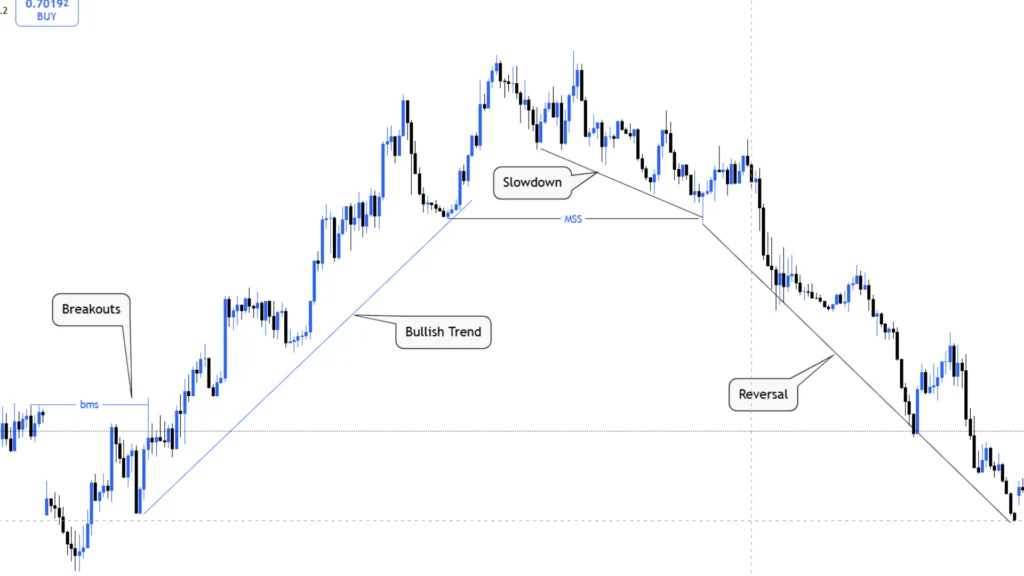
A trend is when prices keep moving in one direction for some time. It is not a straight line — it goes up and down a little, but the overall direction stays the same.
Simple definition: A trend is the general direction the market is heading.
Types of trends:
- Uptrend (price goes up): Prices make higher highs and higher lows. The market is climbing.
- Downtrend (price goes down): Prices make lower highs and lower lows. The market is falling.
- Sideways (no clear direction): Prices move left and right without going clearly up or down.
Types of Trends by Time
- Major (long-term): These trends last months or even years. Big movements driven by economic changes.
- Intermediate (medium-term): These last weeks to a few months. Good for swing traders.
- Minor (short-term): These last hours to a few days. Useful for short term forex trend trading strategy traders.
The Stages of a Forex Trend
Every trend goes through four stages. Understanding these stages helps you trade smarter.
- Start of trend: Price breaks out of a quiet zone and starts moving. Volume increases.
- Strong movement: The trend picks up speed. This is the best time to be in the trade.
- Weakening phase: The trend slows down. Smaller moves, more noise.
- Trend reversal: The trend ends and goes the other direction. Trend reversal forex signals appear here.
How to Identify a Trend (Easy Methods)
Trend analysis forex is about spotting which direction the market is going. Here are four easy methods.
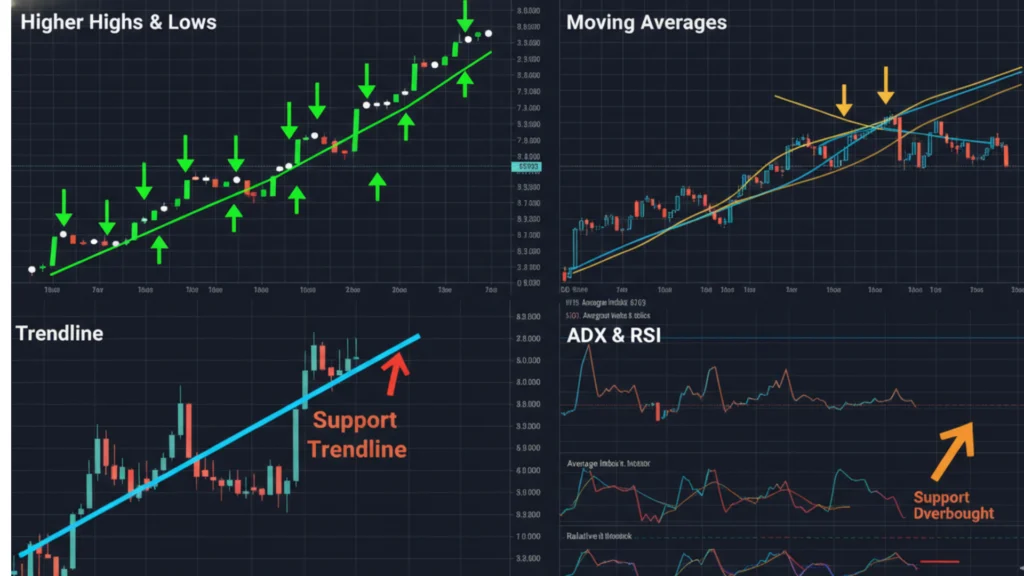
Method 1: Higher Highs & Higher Lows
In an uptrend, every new high is higher than the last one. Every dip is also higher than the last dip. This is the clearest sign of an uptrend. The opposite is true for a downtrend.
Method 2: Using Moving Averages
A moving average smooths out price data so you can see the trend clearly. Moving average forex trend trading is very popular. If the price is above the moving average, the trend is up. If it is below, the trend is down.
Method 3: Trendlines
Draw a straight line connecting the lows in an uptrend or the highs in a downtrend. This is called trend line trading forex. When price stays above the line, the uptrend is alive.
Method 4: Indicators (ADX, RSI)
Indicators are tools built into trading charts. The ADX indicator forex trend trading tells you how strong the trend is. The RSI tells you if the market is overbought or oversold. Both are great for trend confirmation indicators forex.
Best Indicators for Forex Trend Trading
Forex market trend indicators help you see and confirm trends. Here are the most popular ones.
Moving Averages
Moving averages show the average price over a period of time. The 50-day and 200-day moving averages are the most used. They help you stay on the right side of the market.
Relative Strength Index (RSI)
RSI measures the speed of price movement. It goes from 0 to 100. Above 70 means overbought. Below 30 means oversold. It helps you avoid entering at the wrong time.
Bollinger Bands
Bollinger Bands are three lines on the chart. When price moves close to the upper band, the market is strong. When it touches the lower band, the market may be weak. They also show when a breakout is coming.
Average Directional Index (ADX)
ADX is one of the best trend strength indicators forex traders use. A reading above 25 means a strong trend. Below 20 means the market is flat or ranging. Always check ADX before entering a trend trade.
Donchian Channels
Donchian Channels show the highest high and lowest low over a set period. When price breaks above the top channel, it signals an uptrend. When it breaks below, a downtrend may start.
Popular Forex Trend Trading Strategies
There are many profitable forex trend trading strategies. Here are the five most popular ones.
1. Breakout Trading
The forex trend breakout strategy works when price breaks through a key level. You enter the trade as soon as the breakout happens. This is great for catching the start of new trends.
2. Retracement Trading
Price never moves in a straight line. It pulls back before continuing. In retracement trading, you wait for the pullback and enter at a better price. Support and resistance trend trading is used here to find the right spots.
3. Range Trading
Sometimes the market moves sideways. In range trading, you buy at the bottom of the range and sell at the top. But this is not really forex trend trading — it is used when there is no clear trend.
4. News-Based Trend Trading
Big news events like interest rate decisions can start powerful trends. News-based trend trading means you watch the economic calendar and trade after major announcements.
5. Trend Following Strategy
The forex trend following system simply means you stay in the trade as long as the trend continues. You use trailing stops to lock in profits. This is one of the best trend trading strategy forex methods for beginners.
Trading with Price Action
Price action forex trend trading means reading the chart without using many indicators. You study how the price moves and make decisions from that.
What is price action? It is the study of raw price movement. No extra tools — just the candlestick chart.
Candlestick basics: Each candlestick shows you the open, close, high, and low price for a time period. Green candles mean price went up. Red candles mean price went down.
Key patterns:
- Engulfing pattern: A large candle that covers the previous candle. It signals a possible reversal or strong continuation.
- Support & resistance: Support is a price floor where buyers show up. Resistance is a ceiling where sellers take over. These levels help you plan trades.
Chart Patterns for Trend Trading
Trend continuation patterns forex help you spot where the trend will continue after a pause.
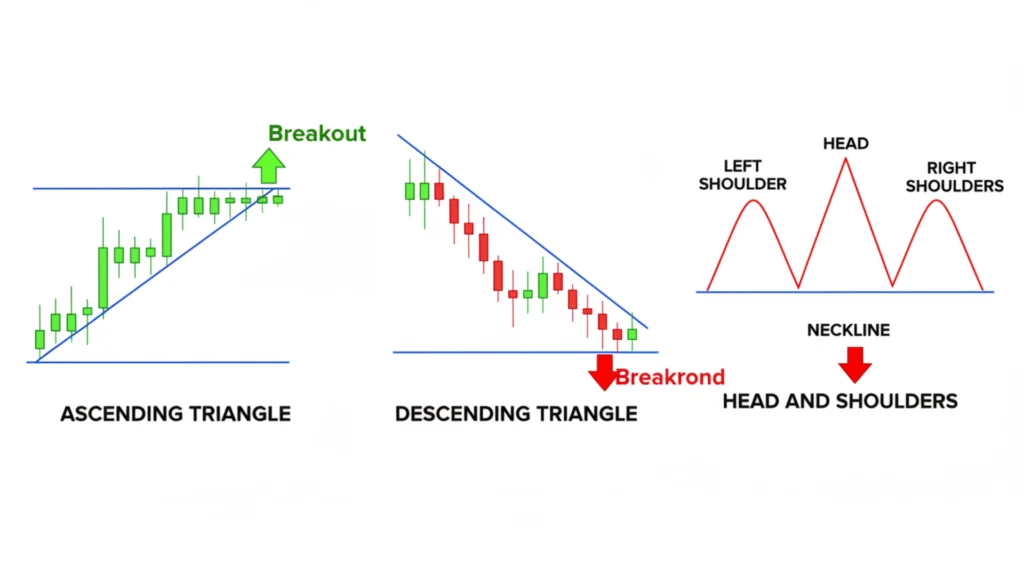
Ascending Triangle
This pattern forms in an uptrend. Price keeps hitting a flat resistance level but makes higher lows. When it breaks through the resistance, the uptrend continues.
Descending Triangle
This is the opposite. Price keeps hitting a flat support level but makes lower highs. When it breaks below support, the downtrend continues.
Head and Shoulders
This pattern signals a trend reversal. It looks like three peaks — a small one, a big one, and another small one. When complete, the trend often reverses direction. Watch for it at the end of long trends.
Step-by-Step Guide to Start Forex Trend Trading
Here is how to do your first forex trend trading step by step.
- Choose a currency pair — Start with EUR/USD or GBP/USD. They are the most popular.
- Open a chart — Use MT4 or MT5. Set your timeframe.
- Identify the trend — Is price going up, down, or sideways?
- Use indicators — Add moving averages and ADX to confirm.
- Confirm entry — Wait for a pullback or breakout signal.
- Place trade — Set stop loss and take profit before entering.
When to Enter a Trade (Simple Rules)
Knowing the forex trend entry and exit strategy is very important.
- Enter in direction of trend — Never fight the trend. Always trade with it.
- Wait for confirmation — Do not jump in too early. Wait for a clear signal.
- Avoid late entries — If you missed the beginning of the move, wait for the next setup. Entering too late means more risk and less reward.
When to Exit a Trade
Exiting correctly is just as important as entering at the right time.
- Take profit: Set a clear target before you enter. When price reaches it, close the trade.
- Stop loss: Always use a stop loss. It protects your money if the trade goes wrong.
- Trailing stop: As the trade moves in your favor, move your stop loss up. This locks in profits and keeps you in the trade longer.
Best Timeframes for Trend Trading
Multi timeframe trend analysis forex helps you see the full picture.
- Short timeframe (fast trades): 15-minute or 1-hour charts. Good for forex trend scalping strategy and quick trades.
- Medium timeframe (balanced): 4-hour charts. Great for swing trading forex trends.
- Long timeframe (safer for beginners): Daily or weekly charts. Better for long term trend trading forex. Less noise, clearer trends.
Real-Life Example of Forex Trend Trading
Let’s say you open your EUR/USD chart on a Monday morning. You notice price has been going up for the last two weeks. The 50-day moving average is pointing up. ADX shows 30 — that means a strong trend.
You wait for a small pullback to the moving average. Price dips and then bounces back up. You buy at 1.0850. You set your stop loss at 1.0800 and your take profit at 1.0950.
Three days later, price hits your take profit. You made 100 pips profit. That is forex trend trading in action — simple, patient, and profitable.
Trends vs Ranges (Important Difference)
Not all markets are trending. Sometimes they just move sideways. This is called a ranging market.
What is a ranging market? Price bounces between two levels without breaking out. It goes up, comes back, goes up again, comes back — no progress in either direction.
When NOT to trend trade: Do not use a forex trend strategy in a ranging market. Your signals will be false and you will lose money. Wait for a clear breakout before entering.
Economic Trends and Currency Movement
Big events in the economy affect how currencies move. Understanding this helps with trend analysis forex.
How news affects trends: A positive jobs report can push a currency up. A poor GDP number can push it down. These moves often start new trends.
Interest rates and inflation: When a country raises interest rates, its currency usually gets stronger. When inflation rises too much, the currency may weaken. These are the forces behind long-term forex trend following system trades.
Risk Management in Forex Trend Trading
No matter how good your strategy is, you must protect your money. This is the most important part of forex trend trading.
- Never risk too much: Only risk 1% to 2% of your account on one trade.
- Use stop loss: Always. No exceptions.
- Risk-reward ratio: Try to make at least 2x what you risk. Risk 50 pips, aim for 100 pips.
- Protect your account: A good account grows slowly. A bad one is blown quickly.
Common Mistakes in Trend Trading
Even simple strategies go wrong when traders make these mistakes.
- Trading without a trend: Never trade in a flat, sideways market with a trend strategy.
- Ignoring risk: Skipping stop losses is the fastest way to lose your money.
- Emotional trading: Making decisions based on fear or excitement is dangerous.
- Entering too late: Jumping in at the end of a trend means you catch the reversal — not the profit.
Trading Psychology (Simple Explanation)
Your mindset is just as important as your strategy in forex trend trading.
Fear and greed: Fear makes you exit too early. Greed makes you stay too long. Both destroy profits. Stay balanced.
Patience in trading: Good setups take time to form. Do not rush. Wait for the right moment.
Discipline: Follow your plan every single time. Do not change rules in the middle of a trade.
Trend Trading vs Other Trading Styles
Trend Trading vs Day Trading
In Day Trading Day traders open and close trades in one day. Trend traders hold for days or weeks. Trend trading is less stressful and needs less screen time.
Trend Trading vs Scalping
Scalping means taking many tiny trades every day. Forex trend scalping strategy needs very fast reactions. Trend trading is slower and calmer. It is much easier for beginners.
Which One is Better for Beginners?
Trend trading wins for beginners. It gives you time to think, plan, and act without panic. Start with trend trading before trying faster styles.
Best Tools & Platforms for Forex Trend Trading
- Trading platforms: MT4 and MT5 are the most popular. They are free and packed with tools.
- Charts and indicators: All the indicators mentioned in this guide are available on these platforms.
- Demo accounts: Most brokers offer free demo accounts where you trade with fake money. Use it to practice.
How to Practice Without Losing Money
You do not need to risk real money to learn forex trend trading.
- Demo trading: Trade with virtual money on a real platform. Same charts, same tools — zero risk.
- Backtesting: Look at old charts and test your strategy. See how it would have performed in the past.
- Learning slowly: Take your time. Spend weeks on demo before risking real money.
How Much Money Do You Need to Start?
You do not need a lot to begin.
- Small accounts: Some brokers let you start with as little as $10 to $100.
- Large accounts: More money means more flexibility, but also more risk.
- Risk per trade: Always keep it at 1% to 2% of your account. That way, even 10 losses in a row will not wipe you out.
Daily Routine of a Trend Trader
A good routine keeps you consistent and focused.
- Check charts every morning to see what happened overnight.
- Analyze trend — Is it still going in the same direction?
- Place trades if a good setup appears. If not, wait.
- Review performance at the end of the day. Learn from every trade.
Simple Trend Trading Checklist
Before every trade, ask yourself these questions:
- ✅ Is there a clear trend?
- ✅ Did I confirm it with indicators?
- ✅ Is my risk controlled with a stop loss?
- ✅ Am I following my trading plan?
If all four answers are yes — go ahead and trade!
FAQs About Forex Trend Trading
What is the Best Strategy?
The best trend trading strategy forex is the one you understand and follow consistently. For beginners, trend following with moving averages is the most reliable.
Is Trend Trading Profitable?
Yes, but only with discipline and proper risk management. Many professional traders make their living with forex trend trading.
Can Beginners Do Forex Trading?
Absolutely. Forex trend trading tips for beginners always say the same thing — start on a demo account, learn slowly, and keep risk low.
What Timeframe is Best?
The daily chart is best for beginners. It is clear, simple, and not too noisy. As you get better, you can try the 4-hour chart for swing trading forex trends.
Final Tips for Success in Forex Trend Trading
Here are your four golden rules for forex trend trading success:
- Follow the trend — Always trade with it, never against it.
- Stay patient — Wait for clear setups. Do not force trades.
- Keep learning — Markets change. Always study and improve.
- Manage risk — Protect your account first. Profits follow discipline.
Forex trend trading is not about being perfect. It is about being consistent. Small, steady wins build big accounts over time. Start simple, stay patient, and trust the process.
