

Have you ever wondered how some people use computers to trade stocks automatically? That’s what a quant trader does. Instead of guessing or going with feelings, a quant trader uses math, data, and smart programs to make trading decisions.
More and more people are interested in this career. Why? Because it combines two cool things — finance and technology. You don’t need to sit and stare at charts all day. Your system does the work for you.
In this guide, you’ll learn exactly what a quant trader is, what skills you need, how to get started, and how much money you can make. Let’s keep it simple and fun.
What Is a Quant Trader? (Easy Explanation)
A quant trader is someone who uses math and computers to decide when to buy or sell things like stocks, currencies, or crypto. The word “quant” comes from “quantitative,” which just means using numbers.
Think of it like this: imagine a robot that watches prices all day. When it sees a pattern — like a price dropping in a way it has seen before — it automatically makes a trade. That robot follows rules built by a quant trader.
A quantitative trader doesn’t rely on gut feelings. Everything is based on data, statistics, and tested strategies. This makes decisions faster and more consistent than human guessing.

What Does a Quant Trader Do?
Daily Tasks (Simple Version)
Every day, a quant trader does a few key things:
- Checking data – Looking at price history, market trends, and news
- Building strategies – Writing rules for when to buy or sell
- Testing ideas – Running old data through new strategies to see if they work
- Placing trades – Letting the system execute trades automatically
It’s more like being a scientist than a traditional trader. You test ideas, look at results, and improve your system step by step.
A Day in the Life of a Quant Trader
- Morning – Check overnight data, review if any automated trading strategies made trades, look at market news
- Afternoon – Write or improve code, work on algorithmic trading systems, fix bugs
- Evening – Run backtesting on new ideas, review results, plan for tomorrow

How Quant Traders Make Money (Step-by-Step)
Here’s a super simple breakdown of how a quant trader earns profit:
- Find patterns in data – Look at historical prices and find repeating trends
- Build a strategy – Create rules: “If price drops 3%, buy. If it rises 5%, sell.”
- Test it – Use old data to check if the strategy would have worked in the past
- Use it in real trading – Run the strategy live with real money
Simple Example: You notice that every Monday morning, a certain stock’s price drops a little. So you build a program that automatically buys it Monday morning and sells it by Wednesday when it usually goes back up. That’s a basic data-driven trading strategy.
Skills You Need to Become a Quant Trader
Technical Skills
To work as a quant trader, you need:
- Basic math – Things like averages, percentages, and statistics
- Statistics – Understanding patterns, probability, and risk
- Programming (Python) – Python for quantitative trading is the most used tool to build and test strategies
You don’t need to be a genius. You just need to be willing to learn step by step.
Soft Skills
Technical knowledge isn’t everything. You also need:
- Patience – Strategies take time to develop and test
- Problem-solving – Things will break. You need to figure out why.
- Curiosity – The best quantitative analysts in trading always ask “why does this pattern happen?”

What Programming Languages Do Quant Traders Use?
- Python – The most popular choice. Easy to learn, has tons of libraries for data analysis and backtesting trading strategies. Perfect for beginners.
- R – Great for statistical analysis. R programming for trading models is widely used in academic and research settings.
- C++ – Used in high-frequency trading (HFT) where speed matters every millisecond. This is more advanced and not needed for beginners.
Start with Python. Once you’re comfortable, explore others.
Step-by-Step Roadmap to Become a Quant Trader
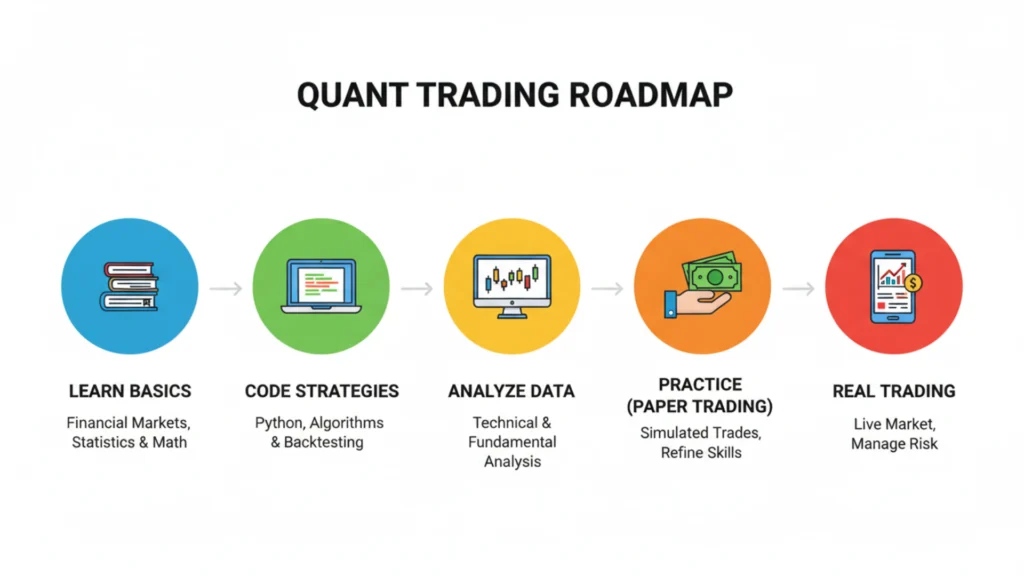
Step 1 – Learn Basics
Start with simple math and coding. Learn Python basics. Understand what stocks and markets are. No experience needed — just start.
Step 2 – Practice with Data
Download free stock data and play with it. Build small projects like tracking price changes or finding averages. This builds your confidence.
Step 3 – Build Strategies
Try to create your first simple rule-based strategy. Something like: “Buy when the price falls below its 10-day average.” This is the beginning of algorithmic trading systems.
Step 4 – Test Without Risk (Paper Trading)
Paper trading means pretending to trade without real money. You test your automated trading strategies in real market conditions but with fake money. This is a safe way to learn.
Step 5 – Start Real Trading
Once your strategy works in testing, you can use a small amount of real money. Start small. Learn. Grow slowly.
Best Tools for Quant Traders (Beginner-Friendly)
- Python – For writing strategies and analyzing data
- Excel – For quick data checks and simple models. Great for beginners.
- Trading platforms – Tools like Alpaca, Interactive Brokers, or QuantConnect allow you to test and run your quant trading tools and platforms easily
Each tool has a purpose. Python is your brain, Excel is your notebook, and trading platforms are your marketplace.
Popular Quant Trading Strategies (Simple Examples)
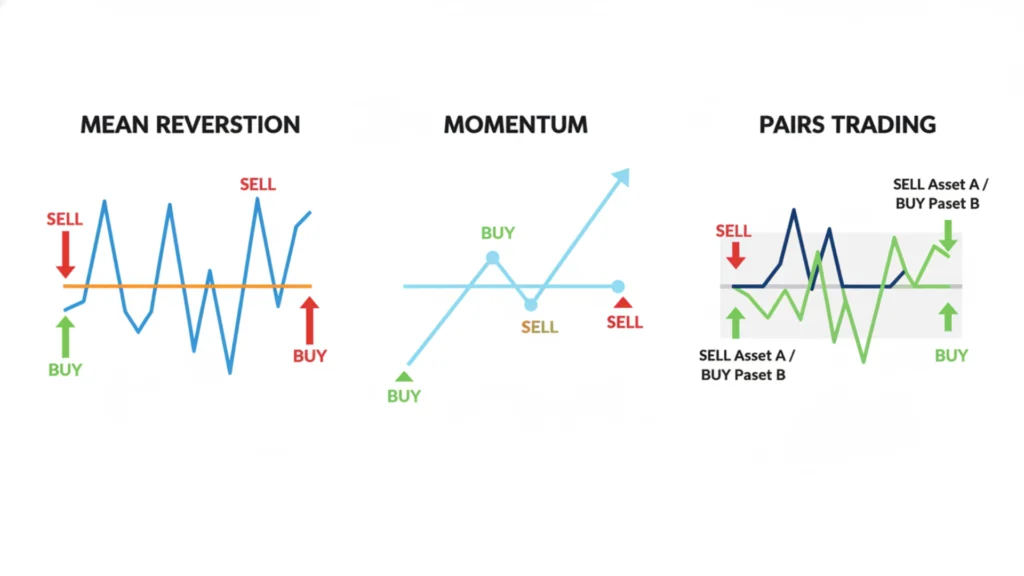
Mean Reversion
This strategy says: “What goes up must come down, and what goes down must come back up.” If a stock price falls way below its average, you buy it. When it bounces back, you sell. Simple and widely used in quantitative finance trading.
Momentum Trading
This one says: “What’s going up will keep going up for a while.” You buy things that are rising fast and sell when the speed slows down. It’s a popular alpha generation strategy.
Pairs Trading
You find two stocks that usually move together. When one goes up and the other doesn’t follow, you bet they’ll balance out. This is called statistical arbitrage trading. It’s clever and data-driven.
Advantages and Disadvantages of Quant Trading
Advantages
- No emotions – The system follows rules. No panic selling or greedy buying.
- Fast decisions – Algorithmic trading systems can react in milliseconds
- Consistent – Same rules applied every time
Disadvantages
- Can lose money – No strategy works 100% of the time. Risk management in quant trading is essential.
- Needs learning – It takes time to understand math, coding, and markets
How Much Do Quant Traders Make?
- Beginner – Around $60,000 to $100,000 per year at a firm
- Experienced – $150,000 to $500,000+ especially in quantitative hedge fund strategies roles
- Freelance/Independent – Unlimited, but also risky. Depends on your strategy’s success.
Salaries vary by country, company, and skill level. Top quant traders at big hedge funds earn millions.
How Long Does It Take to Become a Quant Trader?
- 3–6 months – Learn the basics of math, Python, and markets
- 6–12 months – Build and test your first strategies
- 1–2 years – Become confident and ready for professional or independent trading
Everyone moves at a different pace. Consistent effort beats speed every time.
Can You Become a Quant Trader Without a Degree?
Yes, absolutely. Many successful quant traders are self-taught. What matters most is:
- Can you code?
- Can you build and test strategies?
- Do you have real projects to show?
A strong portfolio of trading projects speaks louder than a degree in many cases. Self-learning through free courses, books, and practice is a real path.
Quant Trader vs Other Careers
Quant Trader vs Data Scientist
Both use data and Python. But a quant trader focuses on financial markets while a data scientist may work in healthcare, retail, or tech. Quant trading has higher income potential but also higher pressure.
Quant Trader vs Day Trader
A day trader watches charts and uses instincts. A quant trader builds systems and lets algorithms decide. Quant trading removes emotions and is more systematic.
Quant Trader vs Software Engineer
A software engineer builds apps and websites. A quantitative analyst in trading builds financial models and algorithms. Some skills overlap, but the goals are very different.
Common Mistakes Beginners Make
- Not testing strategies – Never trade with real money without proper backtesting trading strategies first
- Risking too much money – Start small. Protect your capital.
- Copying others blindly – Strategies that work for one person may fail for you. Understand what you’re using.
Understanding Risk in Quant Trading (Simple)
Every trade has a chance of winning or losing. Risk management in quant trading means controlling how much you can lose.
Think of it like this: if you have $1,000, never risk more than $50 on one trade. That way, even if you lose 10 times in a row, you still have money to keep going.
Good quant traders focus more on not losing than on winning big.
Your First Simple Quant Trading Strategy
Here’s the simplest strategy to start with:
- Buy when a stock’s price drops 5% below its 20-day average
- Sell when it rises back to the average
That’s it. Simple. Test this on historical data using Python. See how it performs. Improve it. This is how systematic trading begins.
Best Free Resources to Learn Quant Trading
- Books – “Quantitative Trading” by Ernest Chan, “Python for Finance” by Yves Hilpisch
- YouTube – Channels like QuantPy, Algorithmic Trading TV, and financial modeling tutorials
- Free Courses – Coursera, edX, and Khan Academy have great math and Python courses for beginners
Start with free resources. You don’t need to spend money to learn the basics.
What Kind of Person Should Become a Quant Trader?
You’d be a great quant trader if you:
- Love working with numbers and logic
- Get curious when something doesn’t make sense
- Are patient enough to test ideas before using them
- Enjoy solving puzzles and problems
If that sounds like you, this career could be a perfect fit.
Myths vs Reality of Quant Trading
Myth: It’s easy money. Build one strategy and get rich fast. Reality: It takes months of learning, testing, and improving. Most strategies fail at first. Success comes from persistence and discipline.
Myth: You need a fancy degree from a top university. Reality: Skills and results matter more. Many self-taught quant traders work at top firms.
Can You Work From Home as a Quant Trader?
Yes! This is one of the best things about being a quant trader:
- Remote jobs – Many firms hire remote quantitative analysts
- Freelancing – Build strategies for clients or funds
- Personal trading – Trade your own capital from anywhere in the world
With a laptop and internet, you can work from home, a café, or anywhere you like.
Final Beginner Checklist
Before you start trading real money, make sure you can check these off:
✔ Learn Python basics ✔ Understand basic math and statistics ✔ Build at least 1 simple strategy ✔ Test it using backtesting tools ✔ Start with a very small amount of real money
Quant Trader FAQs
Question: What is a quant trader?
Answer: A quant trader is someone who uses math, statistics, and computer programs to make financial trading decisions automatically.
Question: Is it hard to learn?
Answer: It takes effort, but with consistent practice and free resources, anyone can learn the basics. Start with Python and simple math.
Question: Do I need a degree?
Answer: No. Skills and a strong project portfolio matter more than a degree in most cases.
Question: How much money do I need to start?
Answer: You can start paper trading with zero real money. When you’re ready, even $500–$1,000 is enough to test your first live strategy safely.
Conclusion: Is Quant Trading Right for You?
Being a quant trader is exciting but not easy. It combines math, coding, and finance in a unique way. You can work from home, earn well, and let systems do the heavy lifting — but only after putting in the hard work to build those systems.
If you love numbers, enjoy solving problems, and have patience, this could be the perfect career path. Start small, learn daily, and don’t give up when things get hard.
The best time to start learning is today.
