
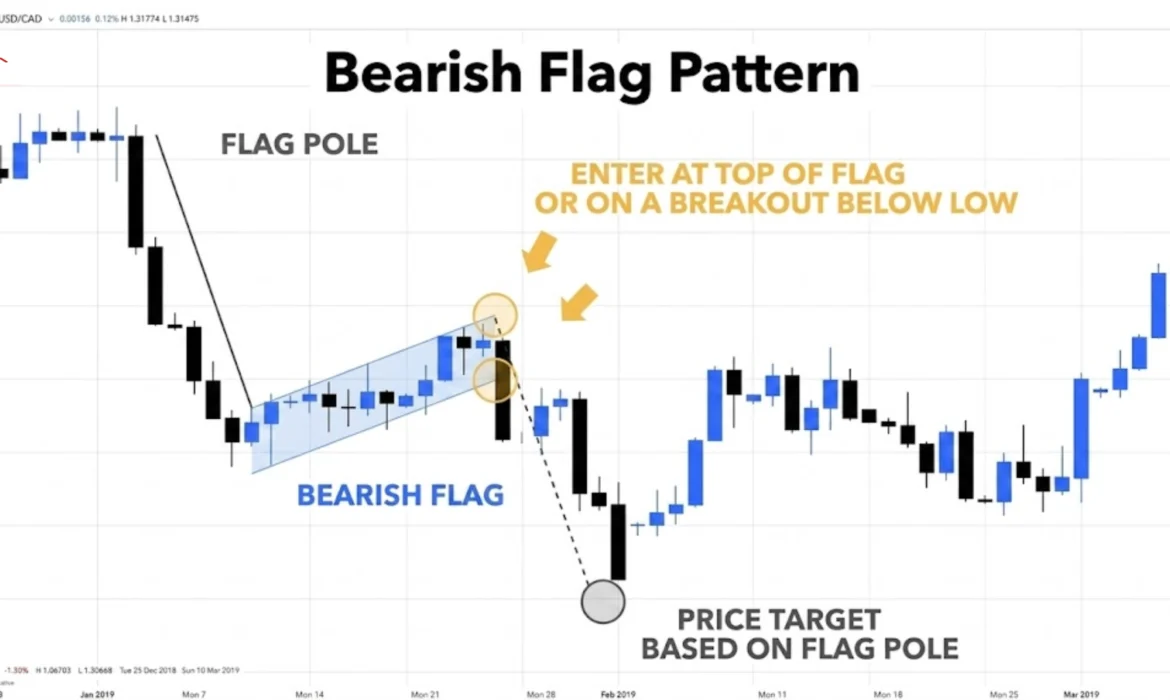
What is a Bearish Flag Pattern?
The bearish flag pattern is a chart pattern in trading where the price first drops sharply, then pauses for a little while, and then drops again. It’s like a ball rolling down a hill, taking a small rest, and then rolling down even more.
It’s called a “flag” because when you look at it on a chart, it really looks like a flag on a pole. The sharp drop is the pole. The small pause or slight rise is the flag itself.
This pattern usually appears in a strong downtrend. That means the market is already moving down, and this pattern is a signal that it will keep going down. Traders use it to find good selling opportunities.
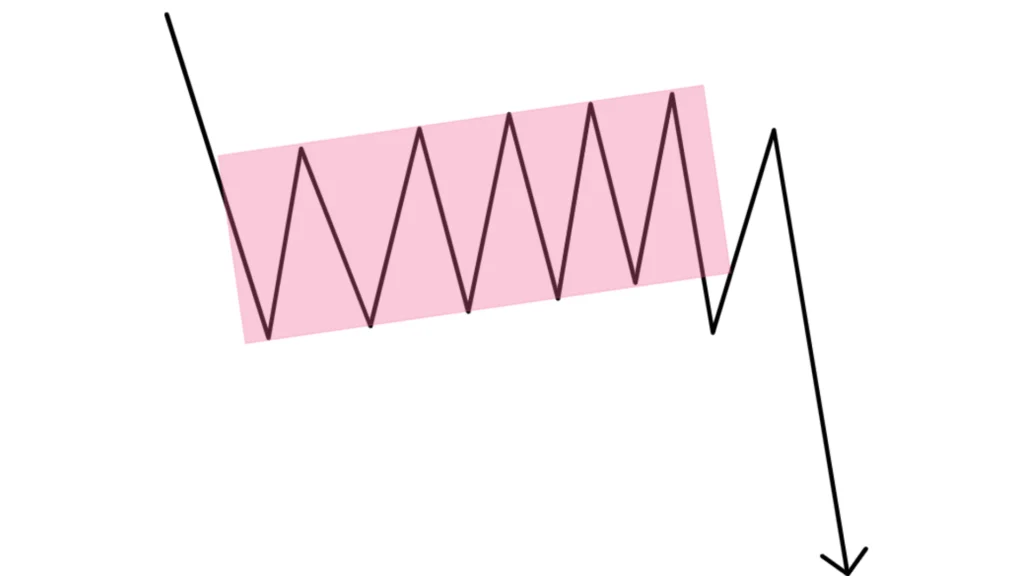
How a Bearish Flag Looks
Let’s paint a picture in your mind. Think of a flag flying outside a building.
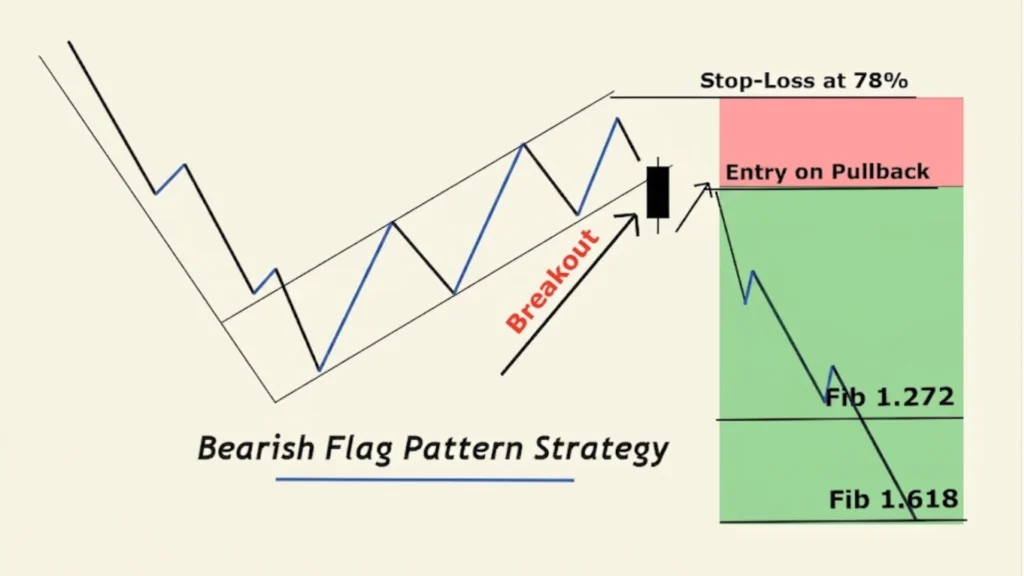
The Flagpole is the long stick going down. In trading, this is the sharp, fast price drop. It happens quickly and strongly. Sellers are in full control here.
The Flag is the small cloth part. In trading, this is when the price moves slightly upward or sideways. It’s a small rest. The price doesn’t go up much — just enough to look like a flag.
The Breakout is when the flag lets go. The price suddenly drops below the flag’s lower edge and continues the downtrend. This is where traders like to sell.
Think of it simply: drop, rest, drop again. That’s the whole bear flag pattern in three words.
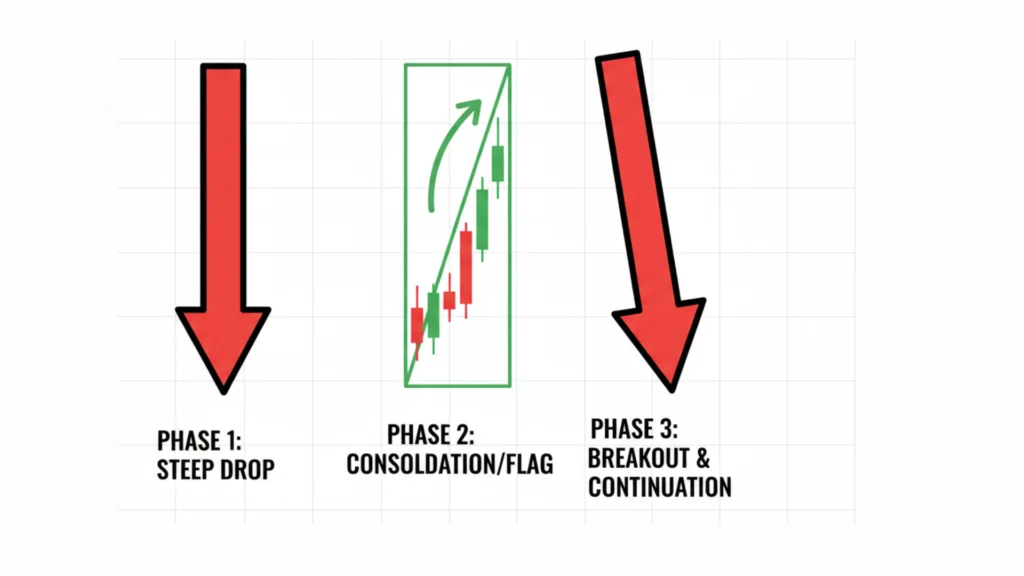
Why the Bearish Flag Pattern Works
Behind every chart pattern, there are real people making decisions. Here’s what’s happening in people’s minds during a bearish continuation pattern:
First, sellers are very strong. They push the price down hard and fast. This creates the flagpole. Everyone is scared or wants to sell.
Then, some buyers think, “The price dropped too fast, let me buy now.” So they start buying a little. The price rises slightly. This creates the flag.
But the big sellers haven’t gone away. They were just waiting. When the price goes up a little, they see it as a chance to sell again — at a better price. So they come back stronger.
The sellers take over again. The price breaks down. This is the breakout. For traders, this moment is the opportunity to enter a short (sell) trade.
Understanding this psychology helps you trust the pattern more.
Key Parts of a Bear Flag Pattern
The Flagpole (Strong Down Move)
The flagpole is the first part. It’s a fast, strong drop in price. This move should be big and clear. If the drop is weak or slow, it’s probably not a real bear flag setup. A strong flagpole shows that sellers are very serious.
The Flag (Consolidation Phase)
The flag is where the price takes a small break. It either moves slightly upward or sideways. This phase usually has lower trading volume, which is a key sign. The flag should look like a small upward channel — two parallel lines going up slightly.
The Breakout Point
This is the moment the flag ends. The price breaks below the lower line of the flag. This is called the bear flag breakout. A real breakout usually happens with a spike in volume. That’s your trading signal.
Volume Behavior (Very Important)
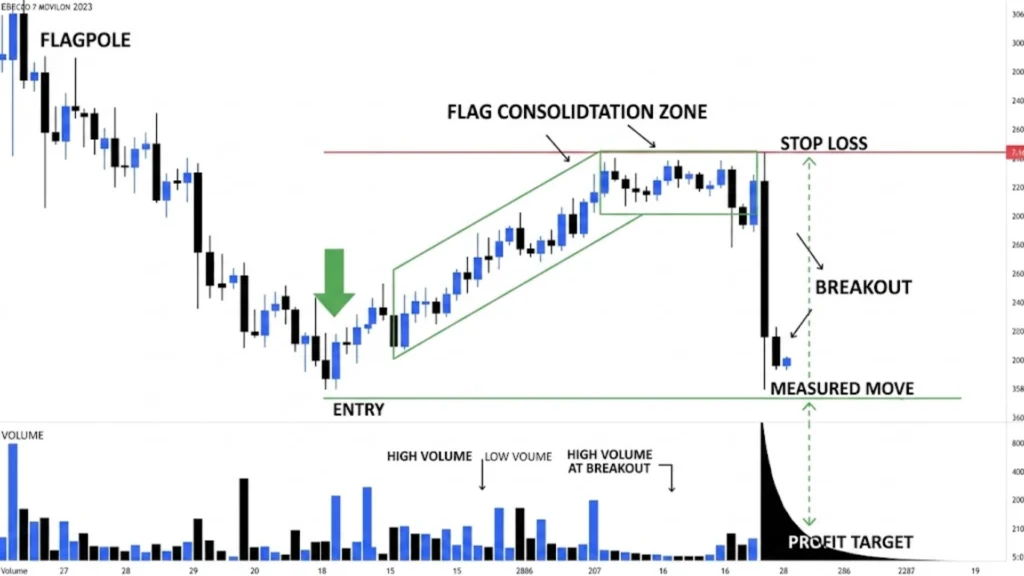
Volume is like the energy behind price moves. During the flagpole, volume is high. During the flag phase, volume goes down. When the breakout happens, volume should go back up. If volume doesn’t increase at breakout, be careful — it could be a false signal.
How to Spot a Bearish Flag Pattern (Step-by-Step)
Spotting a bear flag pattern in live markets is a skill. Here’s how to do it step by step:
- Find a strong downtrend. Look at the chart and find where price dropped fast and hard. This is your flagpole.
- Look for a small upward channel. After the drop, the price should start moving up slightly inside two parallel lines. This is your flag.
- Check decreasing volume. Volume should be getting smaller during the flag. This shows buyers are weak.
- Wait for breakout below support. The price must break below the lower line of the flag. Don’t enter before this happens.
Patience is the key here. Don’t rush.
When Does a Bearish Flag Pattern Form?
The bearish flag doesn’t form at random. It usually shows up in very specific situations:
It forms after strong selling pressure. When sellers have pushed price down hard, the market needs a short rest before continuing.
It forms during market pullbacks. A pullback is when price goes slightly against the trend. In a downtrend, this means a small rise. That small rise often becomes the flag.
It forms in trending markets. This is very important. The bear flag pattern works best in markets that are clearly going down. It does not work well in sideways or choppy markets where there’s no clear direction.
How to Trade a Bearish Flag Pattern (Step-by-Step Guide)
Step 1: Identify the Pattern
Look for the flagpole, flag, and get ready for the breakout. Make sure all three elements are clearly visible on your chart.
Step 2: Wait for Confirmation
Do not enter early. Wait for the price to actually break below the flag’s lower support line. Confirmation is everything in bear flag technical analysis.
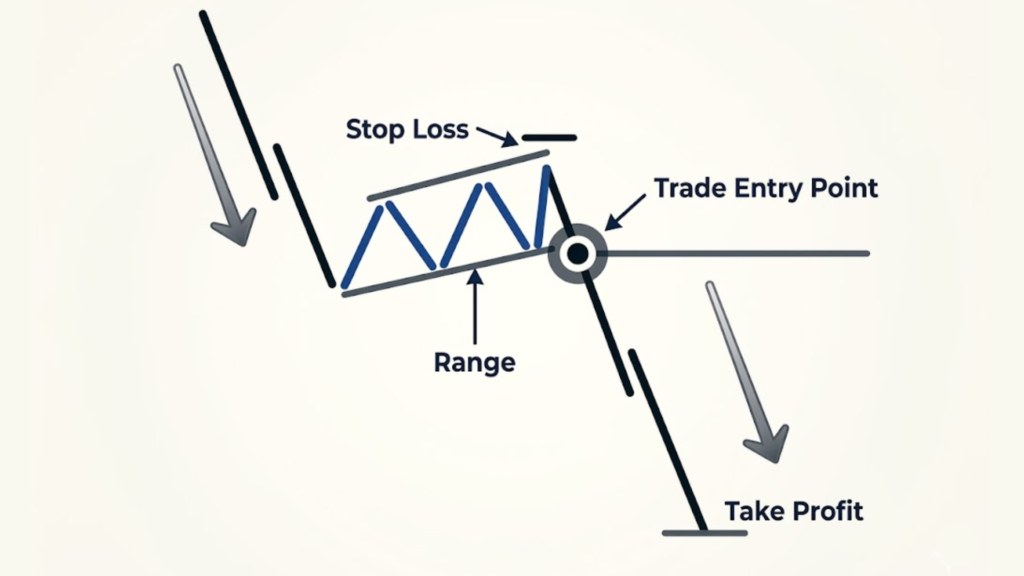
Step 3: Entry Point (Sell Position)
Enter your sell trade right after the breakout candle closes below the lower flag line. Some traders wait for a small retest of the broken level before entering.
Step 4: Stop-Loss Placement (Stay Safe)
Place your bear flag stop loss above the highest point of the flag. If price goes back above that point, the pattern has failed and you should exit safely.
Step 5: Profit Target (Measured Move)
The bear flag profit target is calculated using the measured move. Measure the length of the flagpole. Then subtract that length from the breakout point. That gives you your target.
Step 6: Manage the Trade
Once in the trade, watch it carefully. You can move your stop-loss to breakeven once price moves in your favor. This protects your profit.
Step 7: Review Your Trade
After the trade closes (win or loss), review it. Ask yourself: Did I follow the rules? Was the pattern valid? This helps you grow as a trader.
Real Trade Example (Simple Walkthrough)
Let’s say you’re looking at a stock chart. You see the price drop from $100 to $85 quickly. That’s your flagpole — a $15 drop.
Then the price slowly rises back to $88 over a few days inside a small upward channel. Volume is low during this time. That’s your flag.
Then one morning, the price breaks below the flag’s lower line at $86. Volume spikes. You enter a sell trade at $85.50.
You place your stop-loss at $89 (above the flag). Your profit target is $70 ($85.50 minus the $15 flagpole).
The price drops to $71 over the next week. You exit near your target. Result: a successful trade using the bear flag pattern.
Even if it had failed and hit your stop-loss, your loss would have been small because you used proper risk management.
Bearish Flag Trading Strategies
Classic Breakdown Strategy
Enter right when price breaks below the flag’s lower trendline. Use the measured move for your target. This is the most common bear flag trading strategy.
Flag Retest Strategy
Sometimes after the breakout, price comes back up to test the broken support line (now resistance). Wait for this retest and enter there. This gives you a better entry price and tighter stop-loss.
Volume Confirmation Strategy
Only enter when volume increases significantly at the breakout. If volume is weak, skip the trade. Bear flag volume analysis is one of the most reliable filters.
Multiple Timeframe Strategy
Check the pattern on a higher timeframe (like 4H or Daily). Then go to a lower timeframe (like 15 min) to find a precise entry. This gives you both the big picture and a clean entry.
Best Indicators to Use with Bear Flag
Using indicators alongside the bearish flag pattern makes your trades stronger:
RSI (Relative Strength Index): During the flag phase, RSI often rises to the 50–60 range (overbought on smaller timeframes). When RSI starts falling again, it confirms the bearish move.
Moving Averages: If the price is below the 50-day or 200-day moving average, the downtrend is confirmed. This supports your bear flag trade.
Volume Indicators: Tools like OBV (On-Balance Volume) or Volume Bars help you see if volume is declining in the flag and rising at breakout.
These indicators don’t give signals alone. They simply confirm what the bear flag price action is already telling you.
Bearish Flag vs Other Patterns
Bear Flag vs Bull Flag
A bull flag is the opposite. Price rises sharply (flagpole), then rests slightly downward (flag), then breaks upward. The bear flag breaks downward. Same shape — opposite direction.
Bear Flag vs Bearish Pennant
Both are bearish continuation patterns. The difference is the shape of the consolidation. A bear flag has a rectangular channel. A bearish pennant has a triangle shape (converging lines). Both are valid, but slightly different entries.
Bearish Flag vs Descending Channel
A descending channel is a longer pattern with lower highs and lower lows over time. A bear flag is shorter and appears within a downtrend. The bear flag is faster and sharper.
Best Timeframes for Trading Bear Flags
Scalping (1–5 min): Fast trades, quick moves. Works but requires focus and experience.
Day Trading (15 min–1 hour): Great for catching intraday bear flags. Most day traders prefer this.
Swing Trading (4H–Daily): Larger moves, more reliable signals. Best for beginners who want less stress.
Best for beginners: The 1-hour or 4-hour chart. Signals are clearer and you have more time to think before entering.
Where to Trade Bearish Flag Patterns
The bearish flag pattern works across many markets:
Stocks: Common in individual stocks during earnings season or market downturns.
Forex: Works well on major pairs like EUR/USD or GBP/USD. The bear flag forex strategy is popular among currency traders.
Crypto: Bear flags appear often in Bitcoin and altcoins during bear markets. Bear flag crypto trading can be very profitable but also riskier.
Charting Platforms: TradingView is the best free platform to spot and draw bear flag patterns. It’s easy to use and works for all markets.
How to Avoid Fake Bearish Flags (Common Trap)
Not every bear flag is real. Here’s how to avoid false bear flag breakouts:
Weak breakout: If the breakout candle is small or has no momentum, wait. A real breakout is strong and clear.
No volume confirmation: If volume doesn’t increase at breakout, the move may not last. Always check volume.
Sideways market conditions: If the overall market is moving sideways with no clear downtrend, avoid trading bear flags. They need a trending market to work.
Entering too early: Don’t enter inside the flag. Wait for the actual breakout. Patience protects your money.
Common Beginner Mistakes (And How to Fix Them)
Trading without confirmation: Fix this by waiting for the breakout candle to close. Never enter on a guess.
Ignoring stop-loss: Fix this by always setting your stop-loss before entering. No exceptions.
Overtrading: Fix this by only trading 1–2 setups per day. Quality over quantity always wins.
Misidentifying patterns: Fix this by studying real bear flag pattern examples on historical charts before trading live.
Risk Management Rules (Keep It Simple & Safe)
Good bear flag risk management is what keeps you in the game long-term:
- Risk only 1–2% per trade. Never risk more than this on one trade.
- Always use stop-loss. There are no excuses for skipping this step.
- Don’t chase price. If you missed the entry, wait for the next setup. Chasing leads to bad entries.
- Risk vs reward ratio: Aim for at least 1:2 or 1:3. If you risk $50, your target should be $100–$150.
When NOT to Trade a Bear Flag
Avoid trading the bearish flag in these situations:
- During major news events (like interest rate decisions or earnings). News can break patterns instantly.
- In low-volume markets (like holidays or early morning). Moves aren’t reliable.
- In choppy or sideways trends. The pattern only works in clear downtrends.
How Much Profit Can You Expect?
Be realistic. The bear flag pattern is reliable, but it doesn’t win every time. Most experienced traders aim for a 55–65% win rate with this pattern.
The measured move concept means your profit target equals the length of the flagpole. If the flagpole is 10%, your target is a 10% move after breakout.
With a 1:2 risk-reward ratio, even a 50% win rate makes you profitable over time. Focus on consistency, not big wins.
Quick Checklist Before You Enter a Trade
Before entering any bear flag trade, go through this checklist:
✔ Strong downtrend confirmed
✔ Clear flagpole visible
✔ Flag shows parallel upward channel
✔ Volume decreasing during flag
✔ Breakout confirmed with strong candle
✔ Stop-loss placed above the flag
✔ Profit target calculated using measured move
✔ Risk is only 1–2% of account
If even one box is not checked, wait for a better setup.
Advantages and Disadvantages of Bearish Flag Pattern
Advantages
The bearish flag is easy to spot on charts, even for beginners. It works well in trending markets and gives you clear entry and exit points. The rules are simple and consistent.
Disadvantages
False breakouts do happen, especially in choppy markets. It always needs confirmation before entering. It’s not reliable in sideways or low-volume conditions.
Practice Guide: Try It Yourself
The best way to learn is by doing. Here’s a simple practice plan:
- Open a free chart on TradingView.
- Pick any stock, forex pair, or crypto that has been trending down.
- Look back at the chart and find 3 clear bear flag patterns.
- Mark the flagpole, flag, and breakout on each one.
- Write down where your entry, stop-loss, and target would have been.
Do this daily for 2 weeks. You’ll start spotting bearish flag patterns quickly and naturally.
FAQs About Bearish Flag Pattern
Question: Is bearish flag pattern good for beginners?
Answer: Yes! It’s one of the easiest chart patterns to learn. Start on the 1-hour or 4-hour chart.
Question: Does bearish flag work in crypto trading?
Answer: Yes. Bear flag crypto trading is very common. Bitcoin and major altcoins frequently form this pattern during downtrends.
Question: How accurate is it?
Answer: Studies suggest bear flags have a success rate of around 60–70% when traded with proper confirmation and volume. It’s not perfect, but it’s reliable.
Question: Can bearish flag fail?
Answer: Yes. All patterns fail sometimes. That’s why stop-loss and risk management are non-negotiable.
Question: What is the best timeframe?
Answer: For beginners, the 4-hour or daily chart is best. For experienced traders, even the 15-minute chart works well.
Simple Summary (Quick Recap)
The bearish flag pattern is a powerful tool for traders who want to trade in the direction of the downtrend.
What it bearish flag: A sharp price drop (flagpole), a small pause moving up or sideways (flag), and then another drop (breakout).
How to spot bearish flag: Look for a strong downtrend, a small upward channel with decreasing volume, and a breakout below the flag.
How to trade it: Wait for breakout confirmation, enter sell, place stop-loss above the flag, and target the measured move.
Key rules to remember: Always confirm the breakout. Always use stop-loss. Only trade in trending markets. Manage your risk every single time.
Master these simple rules, and the bear flag trading strategy can become one of your most reliable tools in the market.
